The K9 Dug Beneath Her Porch—Then the Navy SEAL Froze at What He Found Below
Dirt flew beneath the German Shepherd’s frantic claws, wood splintering as the canine dug with lethal desperation.
When moonlight finally struck cold steel, retired Navy SEAL David Huckabee ordered his dog back.
He instantly recognized the biometric lock.
Whatever was buried beneath this quiet widow’s porch was undeniably military.
The fog rolling off the jagged coastline of Cape Elizabeth, Maine, was thick enough to swallow a man whole.
It was the kind of damp, bone-chilling mist that muffled sound and played tricks on the eyes.
For David Huckabee, it felt a little too much like the coastal insertions he used to run during his fifteen years in the Naval Special Warfare Development Group.
But those days were behind him.
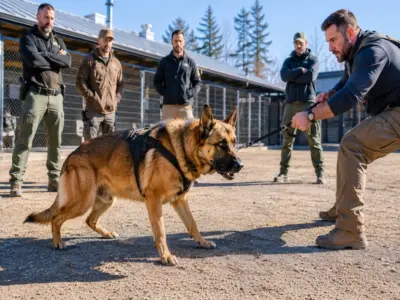
Now he traded covert ops for the quiet, lucrative world of high-end private security, partnered with the only operative he trusted anymore—a ninety-pound, battle-scarred German Shepherd named Titan.
Titan wasn’t a pet. He was a piece of highly calibrated tactical machinery.
Bred in the working lines of East Germany, the canine had deployed with David to some of the most unforgiving corners of the globe.
The dog was trained to find things that did not want to be found: explosives, narcotics, and men who hid in the dark.
The job on a bleak Tuesday evening seemed entirely beneath their pay grade, but the desperation in the client’s voice had convinced David to take the two-hour drive up the coast.
The client was Sarah Jennings, a sixty-two-year-old retired high school English teacher who lived alone in a sprawling cedar-shingled Victorian house perched on a cliffside overlooking the Atlantic.
Five years ago, her husband, Arthur Jennings—a quiet, seemingly unremarkable actuary for a logistics firm in Boston—had perished in a tragic offshore sailing accident.
His body was never recovered.
Since then, Sarah had lived a quiet, solitary life.
But over the past three weeks, the silence of her home had been broken.
“It started as a scratching,” Sarah explained, her hands trembling as she poured David a cup of black coffee in her warmly lit kitchen.
She looked exhausted. Dark circles bruised beneath her eyes.
“Just a faint, rhythmic scratching. At first, I thought it was rats in the crawl space. Then it became heavier. Footsteps. A low, mechanical hum that makes the floorboards vibrate at two in the morning. I called the local police. Officer Mitchell came out twice. He shined his flashlight under the porch, told me it was probably a raccoon or a restless black bear looking for a den, and told me to buy some traps.”
Sarah gripped the edge of the kitchen island, her knuckles white.
“Mr. Huckabee, I know what a bear sounds like. I know what settling wood sounds like. There is a man under my house. I can feel him breathing down there.”
David took a sip of the coffee, his ice-blue eyes scanning the kitchen.
He was a man built out of granite and old habits, standing six foot two with the quiet, coiled posture of a predator.
“Why didn’t you stay at a hotel, Mrs. Jennings?”
“Because this is my home,” she said, her voice finding a sudden, fierce steel. “And Arthur built the wraparound porch with his own two hands. I’m not being chased out by a squatter.”
David set the mug down.
He looked down at Titan, who was sitting at heel, perfectly still.
His amber eyes were locked on the floorboards near the mudroom. The dog’s ears were swiveled forward, pinned like radar dishes toward the foundation of the house.
“All right,” David said, his voice a low, reassuring rumble. “Let’s see who’s trespassing.”
David unclipped Titan’s heavy leather leash.
He didn’t give a verbal command. A simple flick of his wrist was all the canine needed.
Titan instantly went to work.
The massive shepherd dropped his nose to the hardwood, his breathing shifting into the heavy, rhythmic snorts of a tracking sweep.
David followed closely behind, drawing a high-lumen tactical flashlight from his belt.
He kept his right hand free, hovering near the concealed SIG Sauer P226 inside his jacket.
They moved through the house methodically. The living room, the study, the sunroom.
Titan showed zero interest in the interior.
He wasn’t tracking an animal. Animals leave distinct biological markers—urine, dander, fear pheromones.
Titan was ignoring the baseboards, where rodents would scurry.
Instead, the dog moved straight toward the heavy oak door leading to the backyard and the sprawling elevated porch.
“He wants out,” David murmured, opening the door.
The cold main wind whipped off the ocean, carrying the sharp scent of salt and decaying kelp.
But as soon as Titan hit the wooden deck of the porch, his behavior shifted dramatically.
The dog didn’t just sniff. His entire body tensed. The fur along his spine—his hackles—rose in a sharp ridge.
Titan let out a low, guttural chuff, a sound David hadn’t heard since they were clearing Taliban tunnel networks in the Korengal Valley.
It wasn’t the sound of a dog finding a raccoon. It was the payload alert.
The canine bolted off the stairs and darted into the thick lattice skirting that concealed the crawl space beneath the Victorian house.
David heard the wood snap as the ninety-pound dog forced his way through the barrier.
“Titan, hold!” David barked, rushing down the stairs.
He unholstered his weapon, the metallic click of the safety disengaging sounding abnormally loud over the crashing waves below.
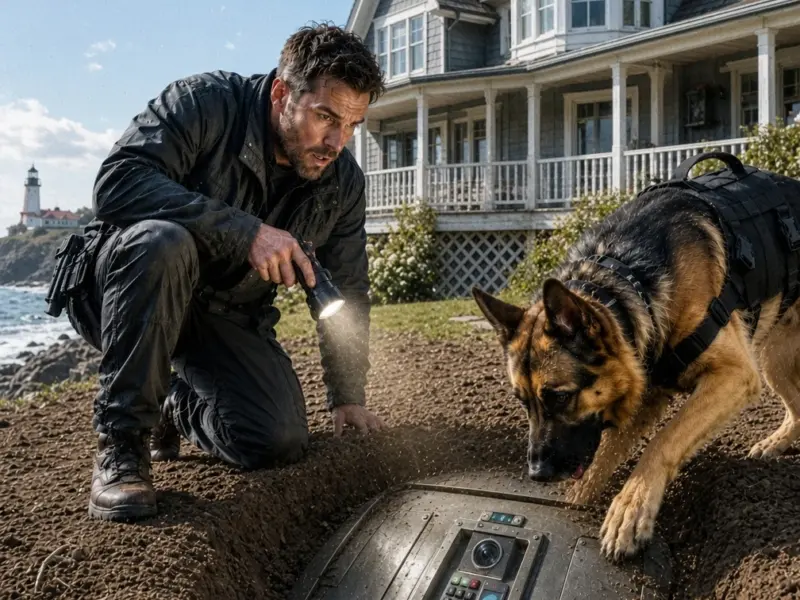
David dropped to his knees in the damp grass and shined his light into the dark cavern beneath the porch.
The beam cut through the gloom, illuminating thick wooden support beams, ancient plumbing pipes, and cobwebs.
And there, in the deepest corner against the stone foundation, was Titan.
The dog wasn’t barking. He was digging, tearing at the packed dirt with a frantic, lethal desperation.
Clumps of damp earth flew through the air as the canine dug with a singular, obsessed focus.
“Mrs. Jennings, stay inside and lock the door,” David commanded without looking back.
He heard the deadbolt click a second later.
David army-crawled into the claustrophobic space, the smell of damp earth and something else hitting his nostrils.
He paused. It was faint, but undeniable to a man who had spent a decade and a half in war zones.
Ozone. Gun oil. And the faint, sharp tang of lithium batteries.
“Titan, aus,” David commanded in German, ordering the dog to drop and cease.
Titan froze instantly, panting heavily, his paws covered in dark mud.
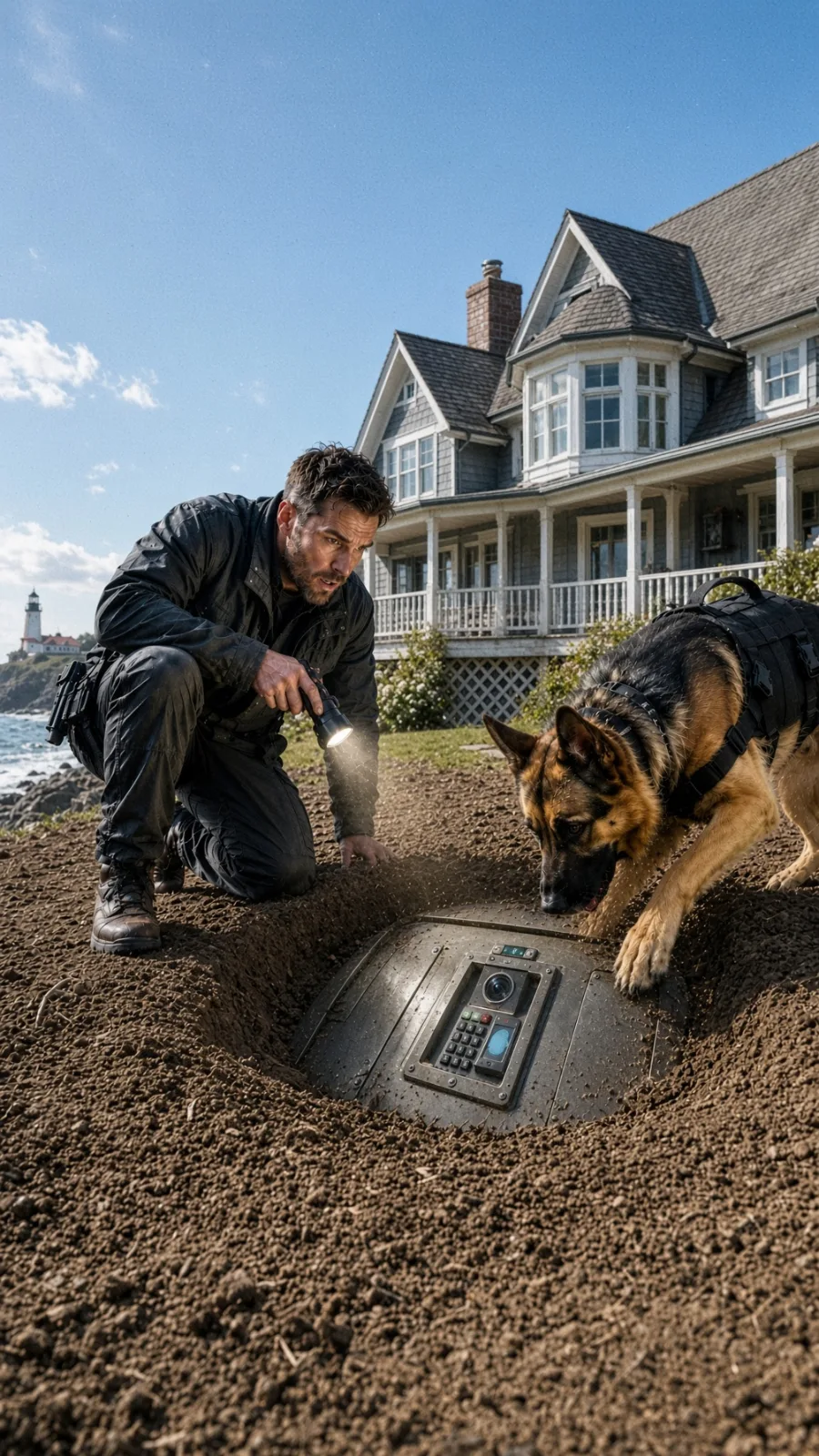
The dog had excavated a nearly three-foot-deep crater in a matter of minutes.
David shimmied his way to the crater, his flashlight held tightly in a tactical grip beside his pistol.
He peered into the hole, expecting to see a buried lockbox—maybe a stash of stolen cash or drugs hidden by a local cartel runner.
Instead, the beam of his light caught the dull, unmistakable gleam of brushed titanium.
David wiped the dirt away with his gloved hand.
What he uncovered wasn’t a box. It was a flat, heavy hatch, seamlessly integrated into a reinforced concrete sleeve that had been poured deep beneath the earth.
The construction was immaculate, designed to be completely invisible unless you knew exactly where to dig.
David’s breath caught in his throat.
He holstered his weapon, leaning in closer.
Wiping away the last layer of wet soil, he revealed a recessed digital panel.
It was completely dark, but the architecture of the mechanism was chillingly familiar.
It featured a biometric thumbprint scanner and a retinal lens, coupled with a twelve-digit alphanumeric keypad.
This was a heavily modified vault door. Not civilian grade. Not even bank grade.
This was the exact type of subterranean ingress hatch used by alphabet agencies to secure black sites and deep-cover safe houses.
“What the hell did you do for a living, Arthur?” David whispered to himself.
He ran his fingers along the edge of the hatch.
The dirt here was looser. The metal was surprisingly clean beneath the top layer of mud.
Someone hadn’t just built this and abandoned it.
Someone had opened this hatch recently. Within the last forty-eight hours.
David backed out of the crawl space, calling Titan to follow.
He stood up on the lawn, brushing the dirt from his jeans, his mind racing.
The scratching, the vibrations, the low mechanical hum Sarah had heard—it wasn’t a phantom.
It was an air filtration system or a generator kicking on.
He walked back into the house.
Sarah was waiting in the kitchen, clutching a heavy cast-iron skillet like a weapon.
“Is it a bear?” she asked, her voice cracking. “Did the dog find a den?”
“Mrs. Jennings, put the pan down,” David said, his voice dead serious.
He didn’t want to panic her, but he needed the truth, and he needed it now.
“I need you to tell me exactly what your husband did for a living.”
Sarah blinked, bewildered.
“Arthur? I told you. He was an actuary. He worked for Global Maritime Logistics in Boston. He assessed risk for shipping cargo. He was a numbers man. He collected vintage stamps and complained about his cholesterol. Why? What did you find under my house?”
“I found a military-grade subterranean access hatch,” David said bluntly.
“Biometric locks. Titanium-reinforced steel. It’s a bunker, Sarah. And it’s active.”
The color drained entirely from Sarah’s face.
She staggered back, hitting the refrigerator.
“That—that’s impossible. We built this house together twenty years ago. Arthur hired contractors from Portland for the foundation. He never—”
She stopped, her eyes widening as a memory surfaced.
“The summer of 2018. We had a foundational crack. Arthur sent me to my sister’s in Vermont for a month while a specialty crew came to pour concrete and reinforce the pylons. He said the insurance covered it.”
“He built a vault,” David said. “And someone has been going in and out of it.”
“But who?” Sarah whispered. “Arthur is dead.”
David didn’t answer.
He walked to the kitchen window, peering out at the foggy property line.
If someone was using that bunker, they had to be entering and exiting under the cover of darkness.
But why? To hide? Or to watch?
“I’m calling the police. I’m calling the FBI,” Sarah said, reaching for the landline.
“No,” David said, stepping forward and pressing his hand over the receiver.
“If this is what I think it is, local cops walking onto this property will get themselves killed. If Arthur was involved in something classified—or worse, something off the books—a uniform showing up will trigger whatever protocol the person down there has in place. I need to get it open.”
“You said it has biometric locks. How are you going to open it?”
David looked down at his duffel bag near the door.
“I spent a decade breaching compounds in the Middle East. Biometrics only work if there’s power. If I cut the primary power and fry the secondary relay with a localized EMP charge—which I keep in my truck for high-threat entries—the magnetic seal will default to an open state. But once I breach it, we have no idea what’s coming out.”
“Do it,” Sarah said, her voice dropping, the panic replaced by a cold, searing anger.
She had mourned a man for five years. Now she realized she might not have known him at all.
“I want to know what’s under my home.”
Ten minutes later, David was back in the dirt.
He had retrieved a small, brick-sized device from his tactical kit—a localized electromagnetic pulse generator.
He slapped it onto the digital keypad of the hatch, wired a detonator, and crawled back to a safe distance behind a concrete pylon, pulling Titan tightly against his chest.
“Fire in the hole,” David muttered, and triggered it.
There was no explosion—just a sharp electronic crack followed by the smell of burning plastic and fried copper wire.
The digital keypad sparked violently, smoking as the circuitry melted.
Deep beneath the earth, a heavy metallic clunk echoed through the foundation.
The magnetic lock had disengaged.
David approached the hatch, pistol drawn.
He wedged a titanium pry bar under the lip of the heavy door and heaved with all his strength.
With a hiss of depressurized air, the heavy door groaned open, falling back on hydraulic hinges.
A shaft of cold, artificial blue light spilled out of the hole, illuminating the dirt.
The air that wafted up didn’t smell like a tomb. It smelled like heavily filtered, climate-controlled air.
It smelled like fresh coffee.
David signaled Titan to hold his position up top and guard the exit.
He gripped his pistol, clicked his flashlight onto the brightest setting, and placed his boots on the steel rungs of the ladder leading down into the blue light.
He descended twenty feet, the air growing colder with every rung.
When his boots hit the metal grating of the floor, David leveled his weapon, sweeping the room.
He expected a high-tech surveillance hub. He expected servers, weapon racks, maybe millions in illicit cash.
What he saw made his blood run completely cold.
The room was roughly thirty by forty feet, walls lined with concrete and acoustic foam.
It was a fully functional command center.
Banks of monitors covered the far wall, displaying live high-definition camera feeds.
But they weren’t watching the naval base. They weren’t watching Russian submarines.
They were watching Sarah.
There were cameras hidden in her kitchen, in her living room, in her bedroom.
But that wasn’t what made the Navy SEAL freeze.
Sitting in the center of the room, positioned perfectly under a bright surgical light, was a heavy steel table.
And on that table were detailed tactical dossiers.
David approached slowly, his gun raised.
He looked down at the files.
The top folder was open. It was a comprehensive, heavily detailed profile of David Huckabee.
It included his military service record, his DEVGRU deployments, his psychological evaluations, and a series of photographs showing David walking Titan just yesterday morning in downtown Portland.
Beside his dossier was a long-range sniper rifle, broken down and meticulously cleaned, alongside a list of names.
The first three names on the list were crossed out in red ink.
David recognized the names.
They were his former SEAL teammates from a classified raid in Syria six years ago.
The fourth name on the list was his.
Before David could process the horror of the trap he had just walked into, a heavy mechanical hum echoed from the far corner of the bunker.
A secondary steel door, flush with the wall, began to slide open.
And from the shadows, a man stepped out.
He was older, his hair graying, wearing a faded tactical sweater.
He held a suppressed pistol casually at his side.
“I wondered how long it would take her to call a professional,” the man said.
His voice was calm. Familiar.
David stared at the face illuminated by the blue light.
It was a face he had seen in the framed photographs upstairs on the mantel.
“Arthur Jennings,” David said, his finger tightening on the trigger.
The dead husband smiled.
“Hello, Chief Huckabee. Welcome to my tomb. I’ve been waiting for you.”
The cold, filtered air of the subterranean bunker seemed to freeze the very blood in David Huckabee’s veins.
He kept his SIG Sauer perfectly leveled at the center of Arthur Jennings’s chest.
The man standing before him was supposed to have drowned in a sailing accident off the coast of Nantucket five years ago.
Yet here he was, standing in a multi-million-dollar surveillance vault buried beneath his grieving widow’s garden, holding a suppressed Heckler & Koch USP.
“Lower the weapon, Arthur,” David commanded, his voice a low, dangerous gravel.
His mind was furiously connecting the scattered fragments of a puzzle he hadn’t even known he was solving.
“Or I end this right now.”
Arthur let out a dry, humorless chuckle.
He didn’t raise his gun, but he didn’t lower it either. He leaned casually against the steel frame of the secondary doorway.
“You always were the quickest trigger in DEVGRU, Chief. But if you shoot me, the biometric dead-man’s switch on my wrist monitor will detonate the thermite charges wired into the ceiling of this bunker. We burn, and my beautiful wife upstairs falls into a sinkhole of fire. So let’s just talk, shall we?”
David’s eyes flicked to Arthur’s left wrist.
A heavy, flashing biometric monitor was strapped tightly to his skin.
David didn’t know if the man was bluffing, but as a professional, he couldn’t afford the risk.
He kept his pistol aimed but adjusted his stance, ready to move.
“You weren’t an actuary for Global Maritime Logistics,” David said, stating it as a fact rather than a question.
“Oh, I was,” Arthur replied, a sinister grin spreading across his aged face.
“But my real employer wasn’t in Boston. It was in Langley. I was a covert logistics asset for the Central Intelligence Agency’s Special Activities Center. I assessed risk, all right. The risk of moving untraceable billions in illicit arms funds through offshore accounts to fund proxy wars.”
David’s jaw tightened.
He looked back at the tactical dossier on the steel table—the crossed-out names of his former SEAL teammates. Miller. Jenkins. Hayes.
“Operation Sandstorm. Six years ago in Syria. We hit a heavily fortified compound expecting a terrorist lieutenant. Instead, we found a server farm. A massive ledger of black-book agency funds.”
“Exactly,” Arthur sighed, shaking his head.
“You boys were just supposed to be a hammer. You weren’t supposed to download the ledgers. When your team brought that drive back, it threatened a global intelligence network. It threatened my network. I had spent a decade skimming millions off the top of those operations to build my own retirement fund.”
“So you faked your death,” David realized, disgust lacing his words.
“You let your wife mourn you for five years, weeping over an empty casket, just so you could hide under her feet and hunt down the men who could expose you.”
“Sarah is safe. I protected her,” Arthur snapped, his calm facade cracking for a fraction of a second.
“The cartel and the agency were both looking for me. If I was dead, Sarah was off the board. She was safe upstairs, and I had the perfect blind spot to operate from. Nobody looks for a dead man under his own porch.”
Arthur took a slow step forward, the blue light catching the cold steel of his suppressor.
“But your team, David—you were a loose end. Miller went down in a botched robbery in Chicago. Jenkins had a heart attack while driving. Hayes—well, Hayes was stubborn, but he ultimately succumbed to a hunting accident. You were the last one left. And getting you to drive out to an isolated cliffside property in the middle of a fog storm? All it took was turning up the ventilation fans so my sweet Sarah would hear the hum and call the best private security firm in the state.”
David realized the absolute brilliance and madness of the trap.
Sarah hadn’t been hearing a mistake. She had been hearing the bait.
“You’re a coward, Arthur,” David said, his grip tightening on his pistol.
“You’re a dead man walking.”
“Maybe,” Arthur smiled, raising his suppressed pistol directly at David’s face. “But you’re a dead man right now.”
Arthur’s finger tightened on the trigger.
But David had spent a lifetime surviving the impossible.
He didn’t dive for cover. Instead, he opened his mouth and let out a piercing, high-frequency tactical whistle—a sound pitched perfectly to cut through the heavy acoustic dampening of the bunker.
Arthur flinched at the sound, his shot going wide. The suppressed bullet zipped past David’s ear, sparking violently against the concrete wall behind him.
Up on the surface, waiting by the open hatch, ninety pounds of East German muscle and absolute loyalty heard the command.
Before Arthur could adjust his aim for a second shot, a shadow eclipsed the blue light spilling from the hatchway.
Titan didn’t use the ladder.
The massive German Shepherd launched himself straight down the twenty-foot drop—a terrifying, silent missile of fur and fangs.
The canine slammed into the heavy steel table in the center of the room, using it to break his fall, scattering the assassination dossiers into the air.
In a millisecond, the dog rebounded off the metal surface, launching himself directly at Arthur Jennings.
Arthur let out a scream of pure terror as Titan’s jaws clamped with bone-crushing force onto his gun arm.
The Heckler & Koch clattered uselessly to the metal grating of the floor.
The kinetic impact of the dog sent the rogue CIA operative crashing backward into the bank of surveillance monitors. Glass shattered in a shower of sparks, plunging half the bunker into darkness.
“Hold!” David roared, sprinting across the room.
Titan maintained his vicious grip on Arthur’s forearm, pinning the older man to the floor—pinning him so fiercely that Arthur couldn’t even reach for the dead-man’s switch on his wrist. The dog growled, a deep, vibrating rumble that shook the floorboards.
David kicked Arthur’s weapon across the room and slammed his boot down on Arthur’s chest.
Without a second of hesitation, David unclipped a heavy tactical zip tie from his belt, securing Arthur’s left arm, making sure the biometric watch remained stable and undisturbed.
“Call him off!” Arthur shrieked, blood pooling on the grated floor. “Call the beast off!”
“Hush,” David leaned down, his face inches from the traitor. “He’s not a beast. He’s my partner. And right now, he’s the only reason you’re breathing.”
David tapped Titan on the shoulder, signaling the release command.
The canine let go, instantly transitioning into a dominant guard stance over the bleeding man—teeth bared, ready to end it if Arthur even twitched.
David pulled a secure, encrypted satellite phone from his tactical vest.
He didn’t dial 911. The local police couldn’t handle a rogue CIA operative and a bunker wired with thermite.
He dialed a direct line to his former commanding officer at JSOC—a man who specialized in cleaning up Langley’s messes.
“I need an extraction and a hazard team at my coordinates,” David spoke quietly into the receiver, keeping his eyes locked on Arthur.
“I found the Sandstorm leak. He’s wrapped in a bow and bleeding on his own floor.”
Ten minutes later, heavily armed, unmarked tactical vehicles rolled silently onto the sprawling cliffside property.
Operators in black gear moved with lethal efficiency, securing the bunker, disarming the thermite charges, and dragging a handcuffed, defeated Arthur Jennings up into the cold night air.
David walked up the ladder, pulling Titan up behind him on a specialized harness.
When they reached the surface, the fog had begun to break, revealing the silver light of a full moon reflecting off the Atlantic Ocean.
Sarah was standing on the wraparound porch, a heavy blanket wrapped tightly around her shoulders.
She watched in stunned, horrified silence as the operatives shoved her dead husband into the back of a blacked-out SUV.
Arthur didn’t even look at her. He just stared at the ground.
David walked up the porch steps, Titan walking calmly at his side.
The dog nudged Sarah’s trembling hand with his wet nose—a silent offering of comfort.
“Was it him?” Sarah asked, her voice hollow, devoid of tears.
The shock was too absolute for crying.
“Yes, ma’am,” David said gently.
He didn’t tell her the extent of the betrayal. He didn’t tell her about the cameras in her bedroom or the assassination plots. She had suffered enough.
“He was involved in some very bad things. But it’s over now. You’re safe. Truly safe.”
Sarah looked down at the massive German Shepherd, slowly stroking his heavy ears.
“You found him,” she whispered to the dog.
Titan let out a soft chuff, sitting loyally at her feet.
David stood in the quiet Maine night, watching the taillights of the government vehicles disappear into the tree line.
The phantom beneath the floorboards was gone, dragged back into the dark world he belonged to.