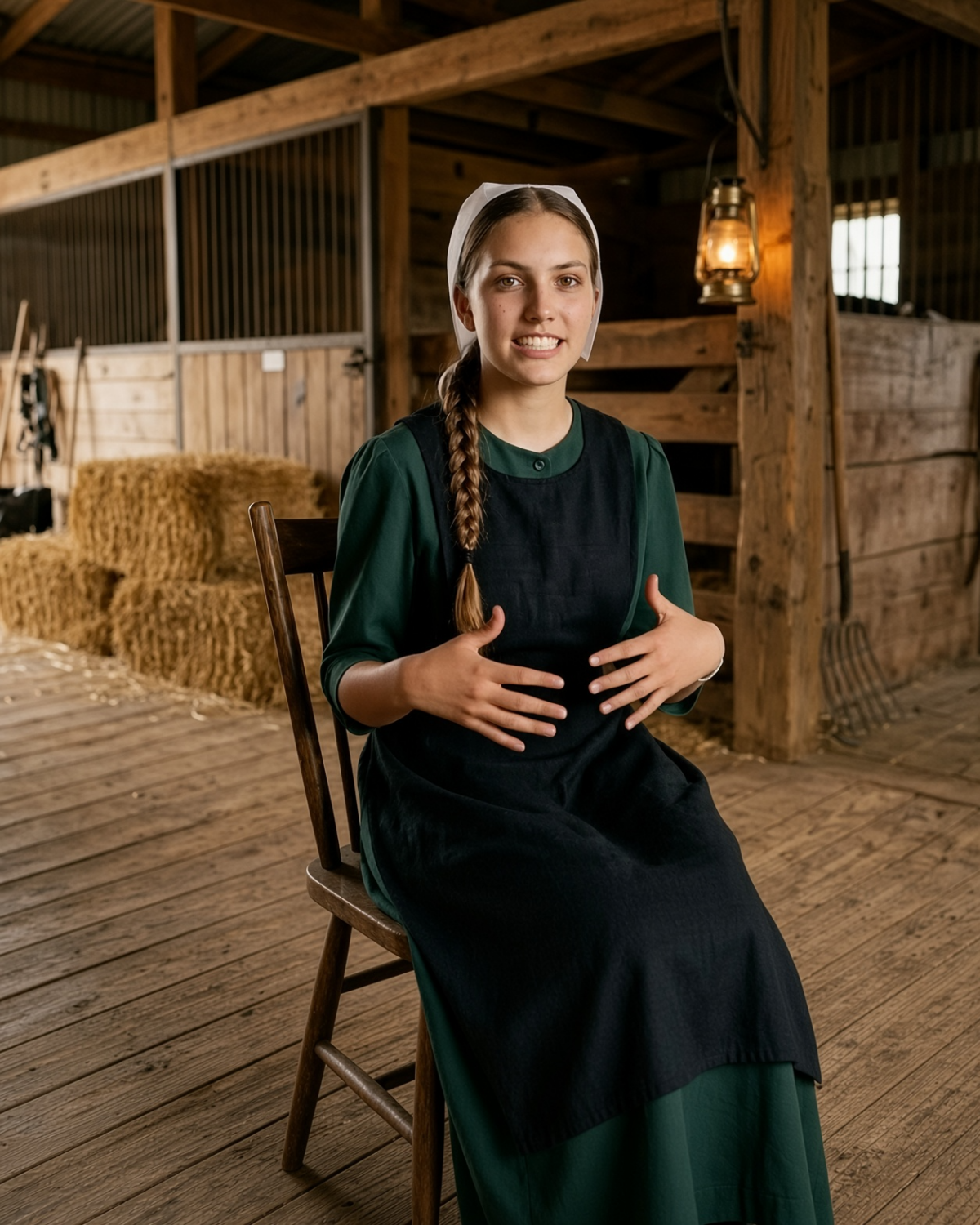
I Went to a Doctor Alone While Pregnant — The Diagnosis Changed My Marriage
The chair in that waiting room was the first chair I had ever sat in that did not belong to someone in my family or my church.
It was orange, the color of a pumpkin left too long in an Ohio field, and the vinyl was split along one armrest, exposing a little patch of yellow foam.
I was twenty-four years old, seven months pregnant, and sitting alone in a medical clinic three and a half miles from my home.
My shoes were too tight because my ankles had swollen so badly that morning. A folded twenty-dollar bill was pinned inside the waistband of my dress, and a false name was written on the clipboard resting in my lap.
My name was Rebecca Stoltzfus, but the receptionist believed I was Rachel King.
My husband, Aaron, thought I was helping my sister can tomatoes.
He had nodded that morning without looking up from his ledger.
And somehow, that small movement of his head had given me the courage to do something I had never imagined doing.
I had gone to a doctor without asking his permission.
A woman in green pants opened the examination-room door and called a name that wasn’t mine.
My hand immediately moved toward my stomach.
The baby had been kicking all morning, but now there was an unusual stillness beneath my dress.
I looked down at the clipboard.
One question had stopped me completely.
Date of last medical appointment.
I had no answer.
I had never been to a doctor in my life.
Not when I had a fever at nine years old. Not when I broke my wrist falling from the haymow at twelve. Not even when I became a bride and heard other young women whisper about the examinations they received before marriage.
I pressed the pen against the paper and drew a line through the empty box.
The ink bled through to the page underneath.
I didn’t know it then, but before that afternoon ended, I would discover that my husband had kept a secret capable of changing everything I believed about our marriage.
And the most frightening part wasn’t that he had lied.
It was that he had known exactly what his silence could cost me.
To understand how a young Amish woman ended up in that orange chair, hiding twenty dollars in her dress and using a name that wasn’t hers, I have to go back five years.
I have to tell you about the first thing Aaron Stoltzfus ever asked me to give up.
And I have to tell you about a woman named Anna, whose grave I once stood beside without understanding that her story was already becoming mine.
I was nineteen when I married Aaron.
The wedding took place in November, in my parents’ front room in Holmes County, Ohio.
There were sixty-three guests, and not enough benches for everyone.
Some people stood along the walls. Others squeezed into the kitchen, where my mother had prepared bread, soup, and enough food to feed twice as many people.
The November wind pushed against the windows, and the smell of wood smoke drifted through the room.
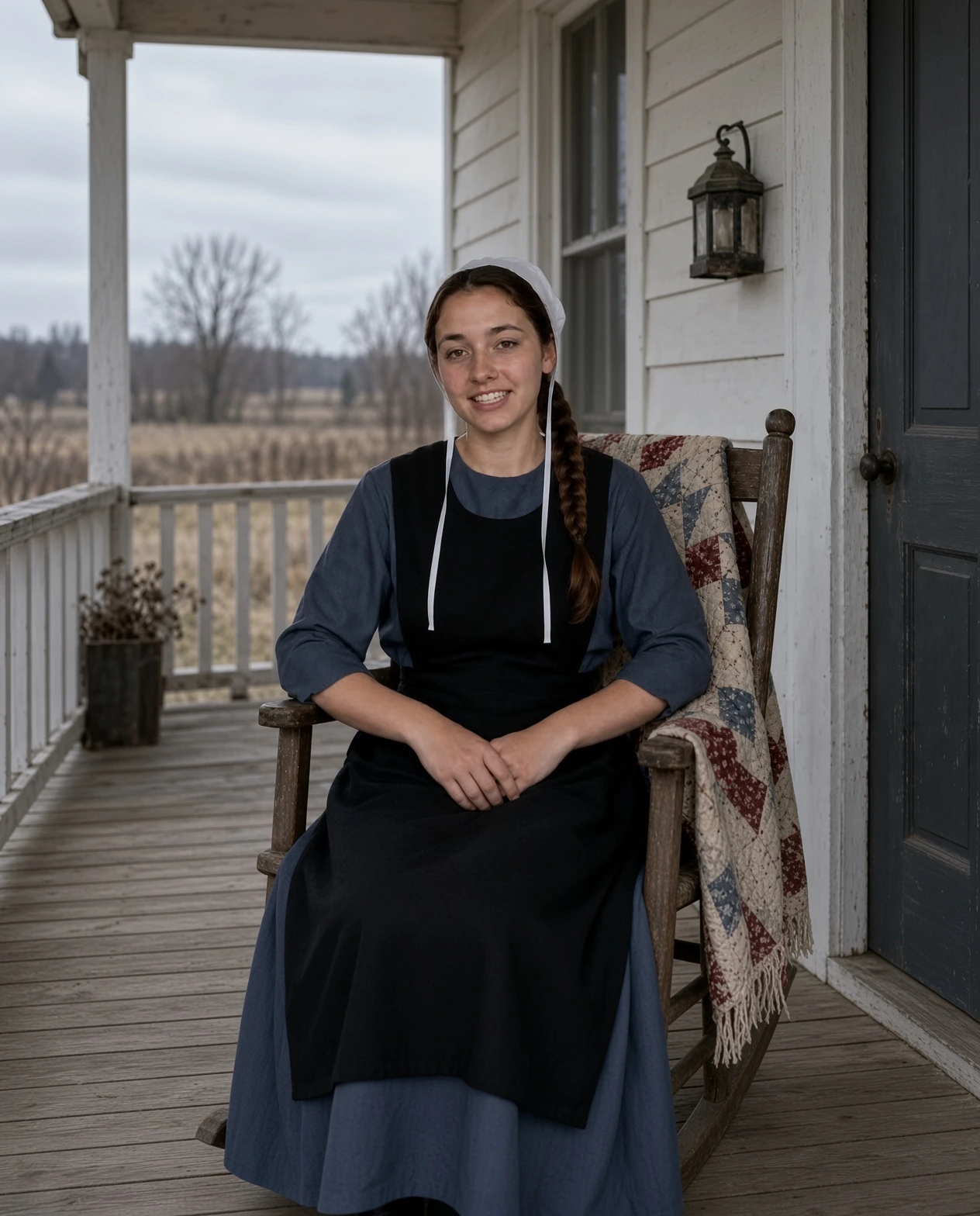
I wore a simple blue dress and a white apron.
Aaron was twenty-six.
He was a widower, although people in our district usually used the gentler expression previously married.
His first wife, Anna, had died during childbirth two winters earlier.
Their baby had not survived either.
Nobody discussed the details.
The bishop had explained that her passing was God’s will, and the congregation had accepted that explanation.
When people mentioned Anna, they lowered their voices and changed the subject.
I knew there had been a hospital in Lancaster, and I knew Aaron had spent several days there before returning home alone.
But I didn’t know what had happened inside that hospital.
I didn’t ask.
A young woman preparing for marriage was not encouraged to question a man’s past, especially when that past involved a deceased wife.
I told myself Aaron was quiet because he was grieving.
I believed that a patient wife could make a home peaceful enough for a grieving husband to find happiness again.
At the time, I thought patience was the same thing as love.
I would spend years discovering how wrong I had been.
The first thing Aaron asked me to surrender seemed almost insignificant.
My mother had taught me to write little notes.
Nothing important.
I wrote down recipes, grocery lists, the names of birds I saw near the fields, and the birthdays of my nieces and nephews.
Sometimes I wrote down thoughts I didn’t want to forget.
I kept everything in a small metal tin that had once held English tea.
It was nothing special.
The paint had worn away around the edges, and the lid made a little clicking sound whenever I opened it.
But I loved that tin.
It was one of the few things I had brought from my childhood home that belonged entirely to me.
Three weeks after our wedding, Aaron entered the kitchen while I was copying a recipe from my mother’s old notebook.
He stood behind me for a moment.
Then he placed his hand flat over the page.
“Rebecca, what are you writing?”
“Just Mother’s recipe for apple butter.”
He looked at the notebook.
Then he looked at the little metal tin beside it.
“You write quite a lot.”
I smiled.
“Only things I want to remember.”
He didn’t smile back.
“A woman who writes too much begins to think too much.”
I waited for him to explain.
He didn’t need to raise his voice.
He never raised his voice.
“And a woman who thinks too much can forget her place.”
I remember looking at his hand resting on my mother’s recipe.
There was nothing threatening about the gesture.
His fingers were relaxed.
His expression was calm.
Yet I felt as though I had been caught doing something shameful.
I closed the tin.
Aaron stepped aside, and I placed it on the high shelf above the stove.
That evening, I told myself I had been foolish.
A married woman had responsibilities.
There were meals to prepare, laundry to wash, animals to feed, and a husband who deserved a peaceful home.
I decided my little notes were unnecessary.
Within a few months, I stopped writing altogether.
I didn’t realize that I had just surrendered the first small piece of my independence.
And Aaron had learned something important.
He had learned that he didn’t need to demand very much.
He only needed to wait until I convinced myself that giving something up was my own idea.
The next thing he gradually took away was my relationship with my younger sister, Miriam.
Miriam was three years younger than I was.
She had always been the more outspoken one.
When we were children, she asked questions that made our mother sigh and our father shake his head.
She wanted to understand everything.
Why certain families followed particular traditions.
Why some people were treated differently.
Why a rule existed when nobody could explain its purpose.
I loved that about her.
Aaron did not.
At first, he simply found reasons why visiting Miriam was inconvenient.
Her husband was too loud.
Her children were too energetic.
Her kitchen was untidy.
Then there was the matter of an English woman Miriam had spoken to at the feed store.
Aaron said that conversation showed poor judgment.
“Your sister is becoming careless,” he told me one evening.
“She was only buying feed.”
“That’s not what I mean.”
I waited.
He shook his head.
“You don’t need to involve yourself in every little thing she does.”
I tried to defend her.
“She’s my sister.”
“And I’m your husband.”
That was the end of the discussion.
It became harder to visit Miriam.
Sometimes Aaron had work for me.
Sometimes he needed me at home.
Sometimes he said the road was too muddy for the buggy.
Eventually, almost a year passed without my sitting at my sister’s kitchen table.
Miriam noticed.
She sent messages through relatives, asking whether I was well.
I always answered that I was fine.
I became very good at saying that.
By then, I had learned that the easiest way to avoid an argument was to make my world smaller.
I had no idea how small it would eventually become.
My first pregnancy came the following year.
I was happy when I discovered I was expecting.
I had imagined motherhood since childhood.
I pictured a little boy sitting beside me while I kneaded bread, or a little girl following me into the garden with muddy shoes.
Aaron was pleased too.
He told his mother before he told most of the other relatives.
His mother, Lydia, arrived the next morning carrying a basket of bread.
She placed it on the kitchen table and looked at my stomach.
“Well, Rebecca, perhaps this house will finally have some laughter in it again.”
I smiled.
I thought she meant she was happy for us.
I didn’t understand that she was also thinking about Anna.
During that pregnancy, I relied on the local midwife, Sarah Beiler.
Sarah was an experienced woman who had helped several families in our district.
She was not someone who frightened easily.
She asked questions, took notes, and paid attention to things that other people sometimes dismissed.
She came to our house regularly.
She weighed me.
She listened to the baby’s heartbeat.
She asked how I was eating and sleeping.
Aaron tolerated her visits, although I noticed he rarely stayed in the room.
My son, Samuel, was born in August.
He was beautiful.
He had dark hair and tiny fingers that wrapped around mine whenever I held him.
But from the beginning, something seemed different.
He didn’t nurse well.
He slept for long stretches.
Sometimes I would watch his little chest rise and fall and feel an uneasiness I couldn’t explain.
I asked Sarah whether everything was normal.
She told me that some babies were simply quieter than others.
Still, she continued checking him.
When Samuel was one month old, she weighed him.
When he was three months old, she returned and weighed him again.
That second visit changed the atmosphere in my kitchen.
Sarah looked at the number on her scale.
Then she looked at Samuel.
Then she looked at me.
“Rebecca, is there anything you want to tell me?”
I was confused.
“What do you mean?”
She glanced toward the doorway.
Aaron was outside repairing a fence.
“Has he been feeding regularly?”
“Sometimes he gets tired.”
“How tired?”
I looked down at my son.
“I don’t know. He just sleeps.”
Sarah didn’t immediately respond.
She wrote something in her little notebook.
Then she closed it slowly.
“Would you like me to speak with your husband?”
I felt my stomach tighten.
“Is something wrong?”
She hesitated.
“I would like to understand a few things first.”
I wanted to ask more.
I wanted to know what she had seen in that number.
But before I could speak, Aaron entered the kitchen.
Sarah stood up.
She gathered her bag and told me she would return another day.
Aaron walked her to her buggy.
I watched them from the window.
They spoke for several minutes.
I couldn’t hear what they were saying.
When Aaron returned, his expression was different.
Not angry.
Not frightened.
Simply closed.
“Sarah Beiler won’t be coming here again.”
I stared at him.
“Why?”
“Her hands are cold, and her questions are improper.”
“She was only checking Samuel.”
“I know what she was doing.”
“But she said—”
“Rebecca.”
He said my name quietly.
That was enough.
He found another midwife, a younger woman from a district two counties away.
She visited twice.
She asked very little.
She didn’t examine Samuel as carefully as Sarah had.
And Aaron seemed satisfied.
I tried to tell myself that he knew what was best.
I tried to believe that a man who had already lost a wife and child understood these things better than I did.
I didn’t yet know that the questions Sarah had been asking were questions Aaron desperately wanted to keep out of our home.
Samuel lived eleven months.
He died in his crib on a Tuesday morning in July.
I had been outside hanging laundry.
The sun was already hot, and the sheets moved gently in the breeze.
I remember thinking that I needed to finish before the afternoon heat became unbearable.
When I returned inside, the house was unusually quiet.
I will not describe what I saw.
There are memories that remain too painful to put into words, even after twenty years.
I remember calling his name.
I remember the sound of my own voice.
I remember Aaron arriving and taking him from my arms.
I remember the bishop coming later that morning.
My mother arrived shortly afterward.
She held me for a long time.
Lydia came too.
Everyone spoke softly.
Everyone tried to explain something that none of us could understand.
The bishop said the words I had heard before.
“God’s will.”
My mother repeated them.
Lydia repeated them.
Eventually, I repeated them too.
I nodded because nodding was easier than asking why.
I nodded because the people around me seemed to need me to accept what had happened.
But somewhere inside me, something began to change.
A small, hard place formed beneath all the grief.
It wasn’t anger yet.
It was a question.
Why had Sarah Beiler been so concerned?
Why had she looked at Samuel’s weight that way?
Why had Aaron sent her away?
And why did nobody want to talk about any of it?
I tried asking him once.
It was several weeks after the funeral.
We were sitting at the kitchen table.
I had been staring at Samuel’s little wooden cup, which remained on the shelf.
“Aaron?”
He continued eating.
“Yes?”
“Do you think Sarah was worried about Samuel?”
His spoon stopped.
“Why would you ask that?”
“She seemed concerned when she weighed him.”
“She was always concerned.”
“She said she wanted to speak with us.”
Aaron placed his spoon down.
“Rebecca, our son is gone.”
I looked at him.
“I know.”
“Nothing we say now will change that.”
“I only wanted to understand.”
He stared at me for several seconds.
Then he said something I would remember for the rest of my life.
“Some questions only make suffering worse.”
I looked away.
And for a long time, I allowed that sentence to become an answer.
But it wasn’t an answer.
It was a locked door.
For two years after Samuel’s death, I did not become pregnant again.
Nobody said anything directly.
Aaron continued working.
I continued cooking, cleaning, and tending the house.
Our marriage became quieter.
Sometimes I wondered whether he still saw me as his wife or simply as another responsibility he had to manage.
His mother visited every Friday.
She always brought bread, even when we had plenty.
She would sit at the kitchen table, remove her gloves, and ask whether I had been sleeping well.
Then she would mention Anna.
“Anna was the same way, you know.”
I would look up.
“What way?”
“Slow at first. Until she wasn’t.”
I never knew what to say.
Lydia would arrange her gloves beside her basket.
Then she would add another sentence.
“Some women simply have more difficulty carrying children than others.”
Sometimes she would look at me as though she were waiting for a particular reaction.
I began to dread Fridays.
One afternoon, I asked her about Anna.
I had never seen a photograph of Aaron’s first wife.
I didn’t even know what color her eyes had been.
“Did Anna like cooking?”
Lydia looked surprised.
“Why?”
“I thought perhaps I could make something she used to make.”
Her expression changed.
“There’s no reason to bring Anna into this house.”
I felt embarrassed.
“I only wondered.”
“She had her time.”
Lydia picked up her basket.
Then she left.
I watched her walk down the path.
I remember thinking that Anna was the one person in our household who was never allowed to speak, yet somehow her absence controlled everything.
When I finally became pregnant again, it was the spring of my twenty-fourth year.
I knew something was different before I told anyone.
The morning sickness was stronger.
I was tired all the time.
My body seemed to be asking for rest in ways I had never experienced before.
I kept the news to myself for nine weeks.
I told myself I wanted to be certain.
But there was another reason.
For nine weeks, the baby belonged only to me.
Nobody could decide which midwife I would see.
Nobody could tell me what questions were appropriate.
Nobody could remind me that a previous wife had died under similar circumstances.
I could simply sit quietly and imagine a future.
I imagined a healthy child.
I imagined a little girl.
I imagined Miriam visiting with her children and laughing at my kitchen table.
I imagined the kind of home I had wanted when I was nineteen.
One evening, I finally told Aaron.
We were eating corn soup.
I had rehearsed the words several times.
“I think we’re going to have another baby.”
Aaron set down his spoon.
He looked at me for a long moment.
Then he asked, “How long have you known?”
“Not very long.”
“How long, Rebecca?”
“About nine weeks.”
His expression became unreadable.
Then he nodded.
“We will use the midwife from Lancaster.”
I looked up.
“Sarah?”
“No.”
He answered too quickly.
“Not Sarah Beiler. Not anyone from this district. I’ll arrange it.”
I waited for him to explain.
He didn’t.
I nodded.
“All right.”
He returned to his soup.
I sat there wondering why the announcement of a pregnancy had made my husband look as though he had just heard difficult news.
And for the first time, I wondered whether he was afraid of something I didn’t know.
The pregnancy became increasingly difficult.
By my fifth month, my ankles were swollen most evenings.
By the sixth month, even my shoes were uncomfortable.
I began experiencing headaches.
Sometimes there was a ringing in my ears.
Twice, while standing in the kitchen, I became so dizzy that I had to sit on the porch steps.
I told Aaron.
He said it was the summer heat.
I told him my hands were swelling too.
He said I was probably eating too much salt.
I told him I sometimes felt as though the room were moving.
He said his mother had carried six children and never complained.
Then he said something that made me stop breathing for a moment.
“Anna was fragile too. Look what came of being fragile.”
I stared at him.
“What happened to Anna wasn’t because she was fragile.”
He looked at me.
For a moment, I thought he might explain something.
Instead, he returned to his ledger.
“Don’t make trouble where there doesn’t need to be trouble.”
I wanted to ask what he meant.
But the words remained in my throat.
The midwife from Lancaster finally came during my fifth month.
She was a thin woman with a narrow mouth and a tightly pinned cap.
She sat beside my bed and listened to the baby’s heartbeat with a wooden cone.
She didn’t weigh me.
She didn’t take my blood pressure.
She didn’t ask about the headaches.
The entire visit lasted less than fifteen minutes.
When she finished, she said, “The baby sounds fine.”
I looked at her.
“What about the swelling?”
“That’s common.”
“The headaches?”
“Pregnancy brings discomfort.”
I glanced toward Aaron.
He was standing beside the door.
He seemed satisfied.
The midwife packed her belongings, and Aaron paid her before walking her outside.
When the door closed, I remained seated on the bed.
My hand rested against my stomach.
I had never felt so alone in my own house.
I wasn’t a doctor.
I didn’t understand medicine.
But I understood that nobody had really listened to me.
And I had begun to suspect that the person who should have cared most was the person most determined to prevent me from asking questions.
The first real piece of evidence came from my sister.
It happened during a wedding in our district.
Aaron couldn’t prevent me from attending because several members of his family were there, and refusing to go would have created questions.
I wore my best plain dress.
I helped carry dishes into the kitchen.
I smiled when people greeted me.
Then I saw Miriam.
She was standing near the side yard, speaking to another woman.
When she noticed me, she immediately walked toward the pump.
I followed.
For a moment, neither of us spoke.
Miriam looked at my face.
Then she looked at my swollen wrists.
“Rebecca, how are you feeling?”
“I’m fine.”
She shook her head.
“Don’t say that.”
I looked toward the house.
“Aaron is inside.”
“I know.”
She reached beneath her shawl.
Then she pressed a folded piece of paper into my hand.
It was a pamphlet.
A small clinic in town was offering walk-in prenatal care.
The words were printed in English.
There was a telephone number.
And beneath the address was a sentence I read several times.
No insurance needed.
Miriam squeezed my hand.
“Please go.”
I stared at her.
“I can’t.”
“You can.”
“He’ll know.”
“Then don’t tell him.”
I felt my eyes filling.
“What if he asks?”
Miriam’s expression became unusually serious.
“Rebecca, I need you to listen to me.”
I looked at her.
“You’re allowed to see a doctor.”
She paused.
“You’re allowed to know what’s happening inside your own body.”
I wanted to tell her that she didn’t understand.
That marriage was complicated.
That Aaron had responsibilities.
That our church had traditions.
But I couldn’t.
Because deep down, I knew she was right.
Miriam looked toward the house.
Then she leaned closer.
“I don’t want to lose you too.”
Those words stayed with me.
She didn’t explain what she meant.
She didn’t have to.
I folded the pamphlet and slipped it into the lining of my apron.
When I returned inside, Aaron was speaking with his brother.
He didn’t notice anything.
For the next three weeks, that small piece of paper became the most important possession I had.
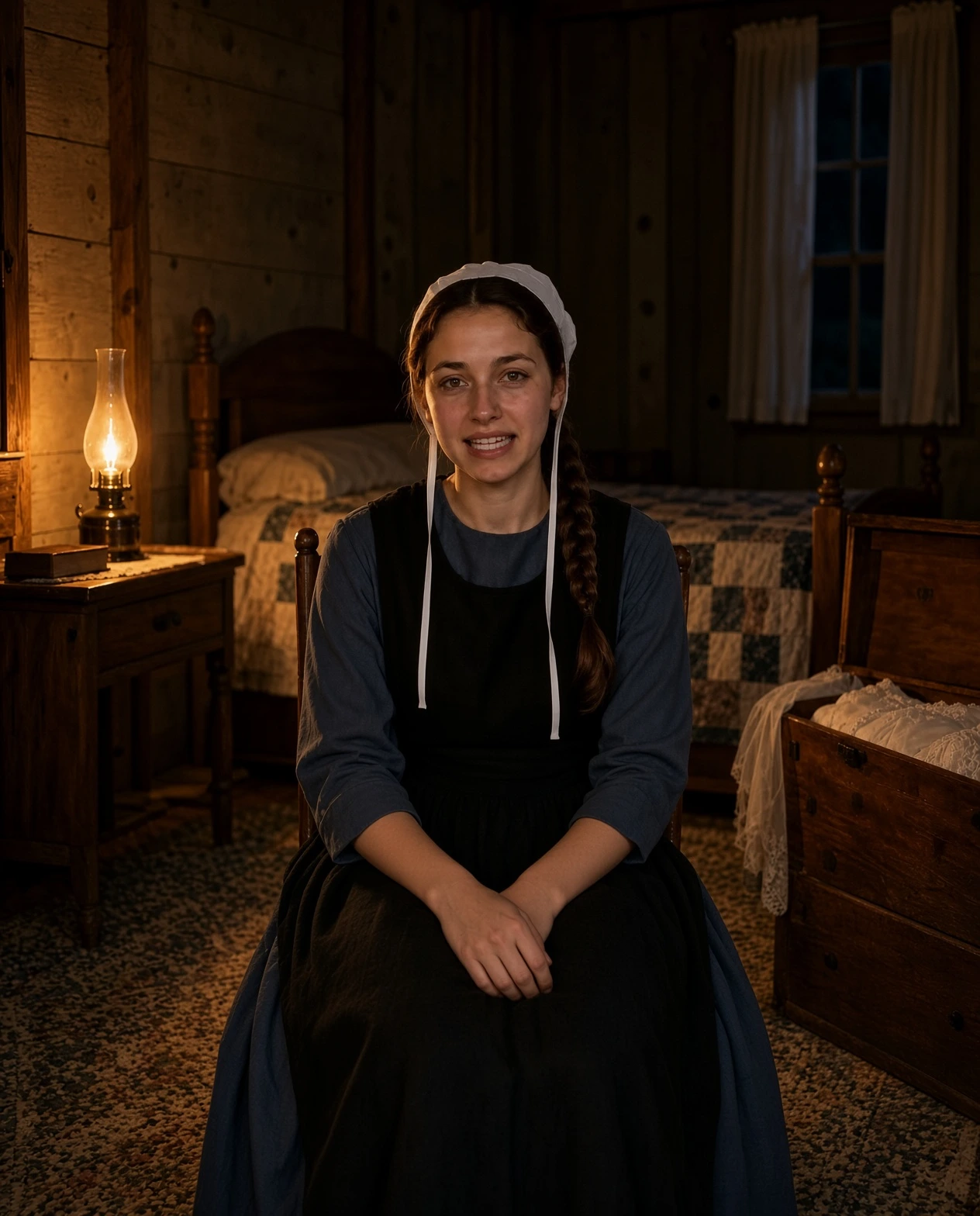
I read it at night in the pantry.
I memorized the clinic’s address.
I practiced saying the telephone number.
I imagined walking through the front door.
Then I imagined Aaron finding out.
Every time, fear won.
Until one morning, the dishwater turned pink.
I was washing plates when I noticed it.
At first, I thought something had stained the basin.
I lifted my hand and looked more carefully.
There was a faint pink color in the water.
It wasn’t much.
It was there for only a moment.
But I saw it.
I stood completely still.
The kitchen smelled of soap and warm bread.
Outside, a wagon passed along the county road.
I looked toward the door.
Aaron was in the barn.
For several seconds, I considered calling him.
Then I thought about the midwife who hadn’t checked my blood pressure.
I thought about Samuel.
I thought about Sarah Beiler’s notebook.
I thought about Anna.
And I thought about Miriam’s words.
You’re allowed to know what’s happening inside your own body.
I dried my hands.
I went to the bedroom.
I found the twenty-dollar bill I had saved from selling a small piece of embroidery months earlier.
I folded it and pinned it inside my waistband.
Then I put on my shoes.
They were too tight.
I walked anyway.
I didn’t tell Aaron where I was going.
I said I was helping Miriam can tomatoes.
He nodded without looking up from his ledger.
That was the moment I knew I would do it.
I walked three and a half miles along the county road.
Every few minutes, I stopped to rest.
The sun was bright.
My back hurt.
My ankles felt heavy.
But I kept going.
When I finally reached the clinic, I almost turned around.
The building was small, with a white sign above the entrance.
A woman at the front desk asked my name.
I hesitated.
Then I said, “Rachel King.”
She asked me to spell it.
I did.
She handed me a clipboard.
And that was how I ended up in the orange chair.
The nurse called my false name.
“Rachel King?”
I stood slowly.
She was young, perhaps twenty-five, with pink scrubs and a kind expression.
“Come with me.”
She led me into a small examination room.
There was a paper-covered table, a metal cabinet, and a poster showing the different stages of pregnancy.
I had never seen anything like it.
She asked me to sit.
“Is this your first pregnancy?”
“No.”
“How many pregnancies have you had?”
“Two.”
“How many children have you delivered?”
“Two.”
She looked at her clipboard.
“Any living children?”
I swallowed.
“Not yet.”
Her expression softened.
“I’m sorry.”
I nodded.
She continued.
“Have you had any prenatal care during this pregnancy?”
I looked down.
“One visit.”
“With an obstetrician?”
“No. A midwife.”
“Do you have any medical records?”
“No.”
“Do you know your blood pressure?”
I shook my head.
She wrapped a cuff around my arm.
The machine made a quiet sound.
She looked at the display.
Then she looked at me.
“Let me check that again.”
She repeated the measurement.
Her expression changed.
“Have you been having headaches?”
“Yes.”
“Any changes in your vision?”
“Sometimes.”
“Swelling in your hands or face?”
I looked at my fingers.
“Yes.”
She stepped out.
A few minutes later, she returned with a doctor.
The woman was older, with gray hair and reading glasses hanging from a chain around her neck.
She introduced herself as Dr. Margaret Ellis.
She pulled a stool toward me and sat down.
Her voice was gentle.
“Mrs. King, I need you to listen carefully.”
I nodded.
“Your blood pressure is dangerously high. I’m concerned that you may have preeclampsia.”
I didn’t understand the word.
She explained that it was a serious pregnancy-related condition requiring immediate medical attention.
She told me they needed additional tests.
Today.
Not tomorrow.
Not after I spoke with my husband.
Today.
“Is there someone we can call?”
I shook my head.
“Does your husband know you’re here?”
I looked at the floor.
“No.”
She didn’t scold me.
She simply waited.
Then she asked, “Has anyone been monitoring your blood pressure during this pregnancy?”
“No.”
“Has anyone checked your urine or performed regular prenatal examinations?”
I shook my head again.
Dr. Ellis wrote something on her paper.
Then she asked about my previous pregnancy.
I told her about Samuel.
I explained that he had been a quiet baby.
That he hadn’t nursed well.
That Sarah Beiler had become concerned about his weight.
That Aaron had stopped allowing her to visit.
The doctor listened without interrupting.
When I finished, she remained quiet.
Then she asked a question I wasn’t expecting.
“Was your husband married before you?”
“Yes.”
“Do you know what his first wife died from?”
I swallowed.
“Childbirth.”
“Was there a known medical complication?”
I shook my head.
The doctor removed her glasses.
She rubbed the bridge of her nose.
Then she looked directly at me.
“Rebecca, I’m going to ask you something important.”
I felt my stomach tighten.
“Do you know whether your husband’s first wife was ever evaluated for an inherited medical condition?”
“No.”
“Did anyone ever discuss a clotting disorder with your family?”
I stared at her.
She continued carefully.
“Some inherited clotting disorders can increase the risk of serious complications during pregnancy. Depending on the condition, they may also affect the health of a developing baby or a newborn.”
I looked at her.
“I don’t understand.”
She leaned forward.
“I’m concerned that there may be a medical history in your husband’s family that nobody has shared with you.”
My hands became cold.
“Why would there be?”
The doctor didn’t answer immediately.
Instead, she asked whether I would authorize her to request records connected to the death of Aaron’s first wife.
I felt something shift inside me.
“Why Anna?”
“Because I believe the information could be important to your safety.”
I looked toward the examination-room door.
Then I looked at my stomach.
The baby moved once.
I placed both hands over it.
The doctor waited.
Finally, I asked, “Could this have happened to my first baby?”
She didn’t give me a definite answer.
She explained that Samuel’s death could not be attributed to an inherited condition without medical evidence.
But she also said his history deserved investigation.
I began to cry.
Not loudly.
I simply covered my face with my hands.
The doctor moved her chair closer.
“Rebecca, I want you to understand something. You haven’t done anything wrong by coming here.”
I looked at her through my tears.
She continued.
“You deserve medical care. And you deserve to know your own medical history.”
Those words were almost too much to hear.
For years, I had believed that asking questions was a form of disobedience.
Now a woman I had known for less than an hour was telling me that my questions were legitimate.
And that my life mattered enough to investigate them.
I remained at the clinic for six hours.
They performed blood tests.
They checked my urine.
They monitored my blood pressure repeatedly.
The numbers remained dangerously high.
Dr. Ellis arranged for me to be transferred to a hospital for further evaluation.
I remember looking at the clock.
I remember the sound of a telephone ringing somewhere down the hallway.
I remember the nurse bringing me water.
And I remember asking the same question several times.
“Is my baby going to be all right?”
Nobody promised me an outcome.
They told me they would do everything they could.
That afternoon, Dr. Ellis returned with a folder.
Her expression was serious.
“We found something.”
I sat up.
“What?”
She placed the folder on the desk.
“Your husband’s first wife was evaluated after her death. The hospital records indicate that doctors identified an inherited clotting disorder.”
I stared at her.
She explained that the records documented a condition affecting the body’s ability to regulate blood clotting.
The exact name was unfamiliar to me.
She pronounced it slowly.
I couldn’t remember it.
She told me that the hospital had documented the risks for future pregnancies.
Then she turned to another page.
There was a signed acknowledgment.
A paper bearing Aaron’s name.
I recognized his handwriting before I understood the words.
The doctor pointed to the date.
Three months after Anna’s death.
“Your husband was informed of the condition and its possible implications for future children.”
I stared at the signature.
It was unmistakably his.
The same careful letters he used in his ledger.
The same handwriting he used when writing notes to the bishop.
I looked up.
“Does it say he understood?”
Dr. Ellis nodded.
“The document indicates that he acknowledged receiving the information and was advised that future partners should receive appropriate medical counseling and evaluation.”
My mouth went dry.
I looked at the paper again.
Then I asked the question that had been growing inside me since the doctor first mentioned Anna.
“Did he know before he married me?”
The doctor looked at the date.
Then she looked at me.
“Yes. The document was signed before your marriage.”
I felt as though the room had become smaller.
I couldn’t hear the hallway anymore.
I couldn’t hear the nurse moving outside.
All I could see was Aaron’s signature.
The signature of the man who had told me not to ask questions.
The man who had sent Sarah Beiler away.
The man who had chosen a midwife who barely examined me.
The man who had allowed me to believe that Samuel’s death was an unanswerable tragedy.
He had known.
He had known that Anna’s medical history might affect another pregnancy.
He had known that medical evaluation was necessary.
And he had married me without telling me.
I looked at the doctor.
“Did he know about Samuel?”
She didn’t pretend to know something the records couldn’t establish.
“These records don’t prove what caused your son’s death. But given the information available to your husband, he should have made sure that you received medical evaluation and counseling before another pregnancy.”
I looked down.
“Why didn’t he tell me?”
Dr. Ellis didn’t answer.
There are questions that medicine can investigate.
And there are questions that only reveal the character of the person who refuses to answer them.
I had spent years believing that Aaron’s silence was a form of grief.
Now I was beginning to understand that some of it had been a choice.
He had known enough to ask questions.
He had known enough to seek advice.
He had known enough to sign a document acknowledging the risks.
But he had never considered that I deserved to read it.
There was one more thing the doctor needed to explain.
The inherited clotting condition and my current pregnancy-related symptoms were not necessarily the same problem.
My blood pressure was dangerously elevated, and the doctors were concerned about preeclampsia.
That condition required immediate management.
The family history required further investigation.
They could not assume that one explained everything.
But both mattered.
And both had been neglected.
Dr. Ellis told me that returning home to the planned arrangement, without appropriate medical monitoring, would place me and the baby at serious risk.
She recommended continued hospital care.
She also asked whether I felt safe returning to my husband.
I looked at her.
I wanted to say yes.
I wanted to say that Aaron was a good man who had simply made a mistake.
I wanted to explain that he had suffered too.
But the image of his signature remained in my mind.
“I don’t know,” I whispered.
The doctor nodded.
“That’s an honest answer.”
She told me that the hospital had a social worker who could help me consider my options.
There were confidential resources.
There was a women’s shelter in the next county.
There was a telephone I could use.
She said I didn’t need to decide the rest of my life that afternoon.
I only needed to make sure I was safe.
I sat on the edge of the bed.
For a long time, I didn’t move.
I thought about Anna.
I had never met her.
I had never seen her photograph.
I had stood beside her grave on my wedding day, surrounded by people who believed I was beginning a happy new life.
I wondered whether she had also sat in a hospital room, frightened and confused.
I wondered whether she had known what was happening.
I thought about Samuel.
His tiny wooden cup.
His dark hair.
His quiet little hands.
I thought about Sarah Beiler looking at the number on her scale.
I thought about the tin of notes above the stove.
I thought about Miriam standing beside the pump.
And then I remembered something the doctor had said.
You deserve to know your own medical history.
I asked the nurse if I could use the telephone.
She brought me one.
I didn’t call Aaron.
I called Miriam.
When she answered, I couldn’t speak at first.
“Rebecca?”
I began crying.
“Something’s wrong.”
Her voice changed immediately.
“Where are you?”
I told her.
She asked whether I was in a hospital.
I said yes.
Then she said, “I’m coming.”
I wanted to explain everything.
I wanted to tell her about the blood pressure, the records, the signature, and Anna.
But all I could manage was one sentence.
“He knew, Miriam.”
There was silence.
Then she said, “I know.”
I closed my eyes.
“You know?”
“I’ve suspected for years that something wasn’t right.”
She paused.
“But I didn’t know what.”
Then she added, “I’m coming to get you.”
Miriam arrived in her husband’s buggy as far as the edge of town.
An English woman she knew drove the rest of the way.
Her name was Elaine.
She was a widow who lived in a small house two counties away.
I had never spoken to her before.
When she saw me, she didn’t ask questions.
She simply helped me into the car.
Miriam sat beside me.
For several miles, nobody spoke.
I watched the familiar farmland disappear behind us.
The fields.
The barns.
The narrow roads.
The houses where I had attended weddings and funerals.
Everything looked the same.
Yet I felt as though I had crossed into another world.
At one point, Miriam reached for my hand.
“Are you frightened?”
I nodded.
“Yes.”
“So am I.”
I looked at her.
She squeezed my fingers.
“But we’re going to get through tonight.”
That was the first promise anyone had made me in a very long time that didn’t come with a condition.
Elaine took me to a small house with a yellow front door.
It was modest.
There were two bedrooms, a narrow kitchen, and a little garden that needed attention.
A yellow curtain hung in the front window.
The furniture didn’t match.
The kitchen table had a scratch across one side.
But when Elaine opened the door, she said something I will never forget.
“You can stay here as long as you need.”
I looked at her.
“Are you sure?”
She smiled.
“Yes.”
I began to cry again.
That night, I slept in a bed that belonged to nobody in my family and nobody in my church.
For the first time in years, nobody told me what I was allowed to think.
Nobody checked what I was writing.
Nobody asked where I had been.
And nobody decided whether I deserved to see a doctor.
The next seven weeks were the longest and most important weeks of my life.
I remained under medical supervision.
The doctors monitored my blood pressure and adjusted my care as needed.
They investigated the inherited condition identified in Anna’s records.
They explained what it could mean for me and for my baby.
There were appointments, tests, consultations, and conversations I had never imagined having.
I learned that medical records could contain answers that a family had hidden for years.
I learned that a diagnosis wasn’t a punishment.
And I learned that asking a doctor a question didn’t make me disloyal to my husband.
Miriam visited whenever she could.
Sometimes she brought food.
Sometimes she brought clothes.
Sometimes she simply sat at the kitchen table and listened.
One afternoon, she found me staring at the yellow front door.
“What are you thinking about?”
I shook my head.
“I keep wondering whether I should have known.”
She pulled out a chair.
“Known what?”
“That something was wrong.”
Miriam looked at me for a long moment.
“Rebecca, you trusted your husband.”
I lowered my eyes.
“Perhaps I trusted him too much.”
“No.”
She reached across the table.
“You trusted someone who had a responsibility to tell you the truth.”
I looked at her.
She continued.
“That isn’t the same thing as being foolish.”
I wanted to believe her.
But guilt is a difficult thing to put down.
For years, I had accepted decisions I hadn’t understood.
I had allowed Aaron to decide who visited our home.
I had stopped seeing my sister.
I had stopped writing.
I had allowed a medical professional to leave my house without asking why she hadn’t checked the things I was worried about.
Now I was left wondering whether every moment of silence had contributed to what happened.
Miriam shook her head.
“You cannot carry responsibility for information someone deliberately kept from you.”
I looked at the table.
There was a small yellow flower in a glass beside her.
I remember thinking that I wanted to believe her more than anything.
Aaron began sending messages through relatives.
At first, they were polite.
He wanted to know when I was coming home.
He wanted to know whether the baby was healthy.
He wanted to speak with me.
Then the messages became more insistent.
His mother sent word that I was embarrassing the family.
The bishop requested a meeting.
A cousin told Miriam that Aaron had been telling people I was confused by the English doctors.
Another relative said I had allowed outsiders to influence me.
Nobody asked why my blood pressure had been dangerously high.
Nobody asked why I had not received regular prenatal care.
Nobody asked why my husband’s signature appeared on a medical document dated before our wedding.
Instead, they wanted to know why I had left.
The answer was simple.
I had left because I wanted to live.
But I wasn’t ready to say those words aloud.
Not yet.
My daughter was born on a Wednesday.
The hospital room was bright.
There were three nurses, one doctor, and Miriam beside my bed.
She held my hand throughout the difficult hours.
Whenever I became frightened, she reminded me to breathe.
Whenever I looked toward the door, she told me she wasn’t going anywhere.
The medical team managed the complications that had placed the pregnancy at risk.
They continued monitoring me and the baby.
When my daughter finally arrived, I heard her cry.
It was a small sound.
But to me, it filled the entire room.
I began crying before I could even see her properly.
A nurse brought her closer.
She was tiny.
Her face was red.
Her fingers curled around the blanket.
Miriam looked at her and smiled.
“She’s beautiful.”
I touched her cheek.
Then I said the name I had been thinking about for weeks.
“Anna.”
Miriam looked at me.
I nodded.
“Her name is Anna.”
I didn’t explain.
I didn’t need to.
I had decided that the woman whose story had been hidden from me would not disappear completely.
My daughter would know her name.
She would know that Anna had existed.
She would know that the past was not something a family could erase simply because discussing it was uncomfortable.
And she would know that her mother had survived because she had finally been given the truth.
For the first time in years, I felt that something good could grow from a story that had begun with so much silence.
Aaron came to the hospital once.
He did not come alone.
The bishop accompanied him.
They entered the room in the late afternoon.
I was sitting beside the window with Anna in my arms.
Miriam was in the hallway speaking with a nurse.
Aaron stood near the foot of the bed.
He looked tired.
His beard was neatly trimmed.
His clothes were clean.
Everything about him looked exactly as it had when he left for work that morning weeks earlier.
The bishop pulled a chair toward the bed.
“Rebecca, we have come because this situation has gone too far.”
I looked at him.
He continued.
“Your husband wants you home.”
Aaron remained silent.
The bishop folded his hands.
“We understand that the doctors have frightened you.”
I looked down at Anna.
“They haven’t frightened me.”
He nodded as though he hadn’t heard.
“Sometimes English doctors don’t understand our ways.”
I looked at him.
“They understood my blood pressure.”
He paused.
“They are not familiar with our community.”
“They understood the medical records.”
The bishop shifted in his chair.
Aaron finally spoke.
“Rebecca, this is not the place to discuss private matters.”
I looked at him.
“Where would you like to discuss them?”
He didn’t answer.
I looked toward the window.
Then I turned back.
“You knew about Anna.”
Aaron’s face changed.
“You knew about the condition.”
He looked at the floor.
“You knew about the hospital’s warning.”
Silence.
I reached toward the bedside table.
The doctor had given me a copy of the relevant document.
I placed it between us.
Then I said the words I had practiced every night since seeing his signature.
“You signed this paper three months after Anna died.”
Aaron looked at the document.
The bishop leaned forward.
“What is this?”
I didn’t look at him.
I looked only at my husband.
“You knew that another pregnancy could be dangerous. You knew that I needed medical evaluation. You knew that future children could be at risk.”
Aaron’s jaw tightened.
Then he said, “I thought things would be different.”
I felt something cold move through my chest.
“Different how?”
He looked at me.
“You were healthy.”
I stared at him.
“You never had me checked.”
“We had a midwife.”
“She didn’t take my blood pressure.”
“She said the baby was fine.”
“She didn’t know about the condition.”
Aaron looked away.
I continued.
“You sent Sarah Beiler away when she asked questions about Samuel.”
His expression hardened.
“That has nothing to do with this.”
“Then why did you send her away?”
He didn’t answer.
I looked at the bishop.
Then I looked back at Aaron.
“You knew about Anna. You knew about the risk. You signed the paper.”
My voice was quieter than I expected.
“And you let me believe Samuel’s death was something nobody could understand.”
Aaron opened his mouth.
Then closed it.
For the first time in our marriage, I did not rush to fill the silence.
The bishop stood.
“Rebecca, you must consider forgiveness.”
I looked at him.
“Forgiveness doesn’t mean pretending I wasn’t lied to.”
He seemed startled.
He glanced toward Aaron.
Then back at me.
“You have a duty to your marriage.”
I placed Anna more comfortably against my chest.
“And I have a duty to my daughter.”
The bishop didn’t respond.
He picked up his coat.
Then he walked toward the door.
Aaron followed him.
Before leaving, he turned once.
I thought he might apologize.
I thought he might say he was sorry.
I thought he might finally explain why he had made the choices he had.
Instead, he said, “I hope you understand what you’re doing.”
I looked at him.
“I do now.”
Then he left.
I never saw my husband again for nine years.
The consequences came quickly.
I was no longer welcome in many homes.
Some relatives stopped answering when I called.
Others spoke to me only through intermediaries.
My mother cried when she heard what had happened.
She sent word that she was praying for me.
My father sent a message through a cousin.
He said he hoped I would find peace.
Neither of them visited.
I don’t blame them entirely.
They had spent their lives believing that obedience was the same thing as goodness.
They had been taught that difficult questions could threaten an entire community.
But I was still their daughter.
And there were nights when I wished they had chosen to sit beside me instead of standing at a distance.
Miriam suffered consequences too.
People questioned why she had helped me.
Her husband was spoken to by members of the community.
She was told that she had encouraged disobedience.
She never told me everything that happened.
Whenever I asked, she changed the subject.
Once, I told her she didn’t have to keep protecting me.
She looked at me and said, “I wasn’t protecting you, Rebecca. I was helping you get somewhere safe.”
I held her hand.
I had spent so many years thinking that my sister was the reckless one.
Now I understood that she had been the bravest person in my life.
I stayed in the little house with the yellow door for almost two years.
During that time, I learned how to do things I had never done before.
I learned to use a telephone without worrying who might overhear me.
I learned to make appointments.
I learned how to read medical instructions.
I learned to ask questions even when someone in authority seemed impatient.
I learned that I could disagree with a person without needing to apologize immediately.
And I learned that a quiet house could be peaceful rather than lonely.
Elaine eventually helped me find work at a fabric store.
At first, I was nervous.
I had spent almost all my adult life doing work that nobody outside the family would ever see.
Now I was standing behind a counter, speaking to customers, measuring fabric, and calculating prices.
The first time someone asked me to write down an order, I froze.
I hadn’t written anything for years.
The customer waited.
I found a pen.
Then I wrote the numbers.
It was a small thing.
But when I looked at the page, I felt something return.
I was still Rebecca.
I had not disappeared.
After a while, I saved enough money to rent a small place of my own.
It wasn’t much.
The kitchen was narrow.
The bedroom window faced a neighbor’s garden.
The heating system made a strange noise whenever the temperature dropped.
But it was mine.
I could leave a book on the table.
I could invite Miriam over.
I could write notes without asking whether anyone thought I was becoming too independent.
And I could raise my daughter without teaching her that silence was the price of being loved.
Anna grew quickly.
She was curious from the beginning.
She asked questions about everything.
Why birds built nests in certain trees.
Why the moon changed shape.
Why people wore different clothes.
Why some families lived differently from others.
Sometimes her questions made me smile.
Sometimes they made me remember the little girl I had been before I married Aaron.
I sent her to public school.
That decision was not easy.
I knew it would create more criticism.
But I wanted her to read everything.
I wanted her to have access to information I had never been allowed to seek.
I wanted her to understand that education was not the enemy of faith.
And I wanted her to know that a doctor was someone she could approach when her body needed care.
When Anna was six, she came home with a school assignment about family history.
She sat at the kitchen table with a pencil.
“Mom, how many grandparents do I have?”
I looked at her.
“Four, if we count everyone.”
She began writing.
Then she asked, “What about my name?”
I smiled.
“Your name belonged to someone important.”
“Who?”
I sat beside her.
I told her about Aaron’s first wife.
I explained that Anna had died before I married her husband.
I told her that she had also been expecting a baby.
I didn’t give her frightening details.
I simply told her that there had been medical problems, and that some of the information had been hidden.
Anna listened.
Then she asked, “Did Dad know?”
I felt my throat tighten.
“Yes.”
“Did he tell you?”
“No.”
She looked at her paper.
Then she asked, “Why not?”
I had no simple answer.
So I gave her the truth.
“Sometimes people are so afraid of what the truth will change that they decide not to tell it.”
Anna thought about that.
Then she wrote something on her paper.
“What are you writing?” I asked.
She turned the page toward me.
Under the family names, she had written:
We should tell each other important things.
I kissed the top of her head.
And I knew that whatever else happened, my daughter would grow up with one rule I had never been given.
Her life would never depend on someone else’s decision to keep her uninformed.
When Anna was twelve, she began asking about the medical condition.
She had overheard Miriam and me discussing a follow-up appointment.
She wanted to know why I had to see a specialist.
I explained that there was an inherited condition in the family history.
I told her that it could affect the way blood clotted and that medical professionals needed to know about it.
She asked whether she might have inherited it.
I told her that we needed proper testing and medical advice.
She asked whether it was something to be ashamed of.
I looked at her.
“No.”
“Then why did nobody talk about it?”
I thought about Aaron’s signature.
I thought about the orange chair.
I thought about all the people who had used the phrase God’s will to end conversations that should never have ended.
“Because some people are afraid of things they don’t understand.”
Anna nodded.
Then she said, “I don’t want to be afraid of knowing.”
Neither did I.
That afternoon, I made a note in a new notebook.
I wrote down the condition’s name.
I wrote down the questions I wanted to ask the doctor.
And I wrote down the date of Anna’s next appointment.
It felt good to put important things on paper.
It felt even better knowing that nobody could take the notebook away.
When Anna turned fifteen, she decided to paint the front door of our house.
The yellow paint had begun peeling.
She asked whether we could choose a different color.
I told her she could choose whatever she liked.
She picked green.
A deep, soft green.
I watched her paint the door on a warm summer afternoon.
There was paint on her hands and a little streak on her cheek.
She stepped back to inspect her work.
“What do you think?”
I smiled.
“I think it looks beautiful.”
She looked at the old yellow paint chips on the ground.
“Did you like it yellow?”
I nodded.
“It was the first safe door I ever walked through.”
She considered that.
Then she looked at the green paint.
“Well, now it’s ours.”
I didn’t say anything.
I simply stood beside her.
Sometimes a person can spend years believing that leaving a place means losing everything.
But watching my daughter paint that door, I understood something different.
Leaving had not taken my life away.
It had given me the chance to build one.
Aaron remarried eventually.
I heard about it through relatives.
His second wife came from a district in Ohio.
Her name was never mentioned when people spoke to me.
I heard that the wedding was modest.
I heard that his mother was pleased.
And I heard, much later, that he had not told his new wife about the medical history.
I cannot prove every detail of what happened in that household.
I only know what was passed along to me.
There was another pregnancy.
There was a baby who did not survive the first year.
And there were questions afterward.
I don’t know whether his second wife is still living in that district.
I don’t know whether anyone told her the truth.
Sometimes I think about her.
I imagine her sitting at a kitchen table, perhaps with a basket of laundry beside her, wondering why nobody is explaining something important.
I wonder whether she has a sister who can reach her.
I wonder whether she has access to a telephone.
I wonder whether she knows that she can seek medical care without asking permission.
I pray for her.
Not in the way the bishop would have expected.
I pray for her health.
I pray that someone tells her the truth.
I pray that she is given the opportunity to make informed decisions about her own body.
And I pray that she never has to sit in an orange chair with a false name on a clipboard just to discover what her husband already knew.
Nine years after I left Aaron, I received a message that he wanted to see me.
I was forty-three.
Anna was nineteen.
She was already talking about studying nursing.
The message came through a cousin.
Aaron had apparently been asking questions about me.
He wanted to know whether I was still living in the same town.
He wanted to know whether Anna was well.
He wanted to know whether I would meet him.
I didn’t answer immediately.
For several days, I thought about it.
Miriam told me I didn’t owe him anything.
But I wanted to hear what he would say.
Not because I wanted to return.
That part of my life was over.
I wanted to know whether he had finally understood what he had done.
We agreed to meet in a public place.
I arrived first.
He looked older than I remembered.
His beard had more gray in it.
His shoulders were slightly rounded.
He wore the same kind of dark clothing he had always worn.
For a moment, I saw the man I had married.
The man who had once stood in my parents’ front room and promised to build a life with me.
Then I remembered the paper.
He sat across from me.
Neither of us spoke immediately.
Finally, he said, “You look well.”
I nodded.
“So do you.”
He looked toward the window.
“Anna is grown now.”
“Yes.”
“She’s studying?”
“She plans to study nursing.”
He nodded.
There was a long silence.
Then he said, “I’ve thought about what happened.”
I waited.
He rubbed his hands together.
“I didn’t know how to explain everything.”
I looked at him.
“You had nine years.”
He didn’t answer.
“I had nine years to think about what you did.”
He looked down.
“I was afraid.”
I stared at him.
“Of what?”
He sighed.
“Of losing another family.”
I felt something inside me tighten.
“Then why did you risk losing another wife?”
He looked up.
I continued.
“You were afraid of telling me the truth, but you weren’t afraid of what could happen if I never learned it.”
He shook his head.
“It wasn’t that simple.”
I waited.
He looked at the table.
“I thought the doctors might have been mistaken.”
“Did you tell me that?”
“No.”
“Did you arrange testing?”
“No.”
“Did you explain Anna’s records?”
He shook his head.
I leaned forward.
“Did you tell me about the paper you signed?”
He remained silent.
I looked at him.
“You didn’t make one mistake, Aaron. You made a choice every time you decided I didn’t need to know.”
He closed his eyes.
For several seconds, neither of us spoke.
Then he said, “I never wanted you to suffer.”
I looked at him.
“Wanting something doesn’t change what you did.”
He began to speak again.
I raised my hand gently.
“Please don’t tell me you loved me. I spent years trying to understand how a man could love his wife and keep something like that from her.”
He looked at me.
I continued.
“Maybe you did love me in the way you understood love. But you didn’t trust me with my own life.”
He didn’t answer.
And that was the last time we spoke privately.
I walked out of the building and stood in the sunlight.
I expected to feel angry.
Instead, I felt tired.
Not the exhausted feeling I had known during my pregnancy.
Something different.
The exhaustion of finally understanding that some people may never offer the apology you deserve.
And that waiting for it can become another way of remaining trapped.
Anna turned twenty that year.
She had grown into a thoughtful young woman.
She read constantly.
She asked questions.
She had a habit of writing things down in little notebooks.
Sometimes I watched her sitting at the kitchen table and felt as though I were looking at the life I might have had if I had never put my mother’s tin on the high shelf.
She knew the name of the inherited condition.
She knew why it mattered.
She had visited the grave of the woman she was named after.
The first time we went, she brought flowers.
We stood beside the grave for several minutes.
The stone was simple.
The lettering had begun to fade.
Anna looked at the name.
“Do you think she knew?”
I understood what she meant.
“About the condition?”
Anna nodded.
I considered my answer.
“I don’t know.”
She placed the flowers near the stone.
“I wish someone had helped her.”
“So do I.”
Anna looked at me.
“Do you think that’s why you gave me her name?”
I nodded.
“Partly.”
“Because you didn’t want anyone to forget her?”
“Yes.”
Anna looked down at the flowers.
Then she said something that surprised me.
“I don’t think her story should only be about how she died.”
I looked at her.
She continued.
“She was a person before she became a tragedy.”
I felt my eyes filling.
“You’re right.”
Anna touched the edge of the stone.
“I wish I could have known her.”
I put my arm around her.
“So do I.”
We stood there for a little longer.
Then we walked back toward the car.
On the way home, I realized that my daughter had understood something I had needed twenty years to learn.
A person’s life should never be reduced to the secret someone else tells about them.
Anna deserved her own story.
And so did I.
I am forty-four years old now.
I still live in the little house.
The yellow door is green.
The kitchen table has a scratch across one side.
The garden is small, but I keep it tidy.
There are birds outside the bedroom window.
I still work at the fabric store, although fewer hours now that Anna is older.
And I still write.
The original tin from my mother’s kitchen is gone.
Aaron’s mother burned it after I left, or so I was told.
For years, I thought losing it was another small tragedy.
Now I have a different tin.
It sits on the table beside my bed.
Inside are recipes, lists, notes, and the names of people I don’t want to forget.
I write down the names of Anna’s friends.
I write down birthdays.
I write down the birds I see in the garden.
Sometimes I write about women from our old district.
Women who might still be sitting in kitchens with difficult questions.
Women who may have been told that certain subjects are private.
Women who may have learned to nod whenever someone tells them that everything is God’s will.
I think about them more often than people realize.
I wonder whether they know they can ask questions.
Whether they know they can call a doctor.
Whether they know that medical information belongs to the person whose health is at stake.
I wonder whether they have someone like Miriam.
And I hope they do.
A few months ago, Anna came home from a nursing-school orientation.
She was excited.
She talked about the hospital.
She talked about the instructors.
She talked about the different areas of medicine she might eventually study.
Then she found me sitting at the kitchen table with my little tin open.
“What are you writing?”
I looked up.
“Just a few things.”
She smiled.
“Still making lists?”
“Always.”
She sat across from me.
Then she noticed a piece of paper beside my notebook.
It was an old copy of the medical document bearing Aaron’s signature.
I had kept it for years.
Not because I wanted to punish him.
Not because I wanted to spend the rest of my life looking backward.
I kept it because it was evidence.
Evidence that my memory was real.
Evidence that I had not imagined the questions Sarah Beiler had asked.
Evidence that the tragedy I had been told to accept without explanation had a medical history that deserved attention.
Anna picked up the paper.
She looked at the signature.
Then she looked at me.
“Does seeing this still hurt?”
I thought about it.
“Sometimes.”
“Why do you keep it?”
I placed my pen down.
“Because there was a time when everyone told me I was wrong to ask questions.”
She waited.
“And this reminds me that I wasn’t.”
Anna folded the paper carefully.
Then she placed it back on the table.
“Mom?”
“Yes?”
“Do you ever wish you had gone to the doctor sooner?”
I looked toward the window.
There was a small bird on the fence.
I watched it for a moment.
Then I answered honestly.
“Every day.”
Anna reached across the table.
“But you went.”
I looked at her.
She smiled.
“You went when you could.”
I squeezed her hand.
That was enough.
Sometimes I still think about the three and a half miles I walked that morning.
I remember the tight shoes.
The heat.
The twenty-dollar bill hidden in my dress.
I remember the false name.
And I remember the orange chair.
I have never forgotten it.
People sometimes ask me what finally gave me the courage to leave.
They expect me to say it was the diagnosis.
They expect me to say that I suddenly understood everything.
They expect a dramatic moment when I discovered the truth and immediately knew what to do.
But that isn’t exactly what happened.
The diagnosis gave me information.
The records gave me evidence.
The doctor gave me a medical explanation.
Miriam gave me somewhere to go.
But the decision began much earlier.
It began when Sarah Beiler looked at Samuel’s weight and asked whether I wanted to tell her something.
It began when Aaron told me I wrote too much.
It began when I stopped visiting my sister.
It began when I learned to accept answers that didn’t answer anything.
And it began again every time I felt something was wrong and convinced myself that I had no right to ask.
I didn’t leave because I suddenly became fearless.
I left because I was frightened enough to understand what could happen if I continued pretending everything was fine.
The diagnosis did not change my marriage.
That is the part people often misunderstand.
My marriage had already changed long before I entered that clinic.
It changed when Aaron decided that my questions were a problem.
It changed when he sent Sarah Beiler away.
It changed when he allowed me to believe Samuel’s death was something nobody could investigate.
It changed when he signed a document in Lancaster and decided that I would never need to see it.
And it changed every morning afterward when he looked at me across the kitchen table and said nothing.
The diagnosis simply gave a name to the truth.
There is one final thing I want people to understand about the orange chair.
For years, I thought of it as the chair where my marriage ended.
I remembered the torn vinyl.
The yellow foam.
The clipboard.
The false name.
Sometimes I imagined that if I had never sat there, my life might have remained easier.
I might have continued living in that farmhouse.
I might have had more children.
I might have grown old beside Aaron.
Perhaps I would never have known what he had signed.
But then I think about Anna.
I think about her green-painted door.
I think about her notebooks.
I think about her studying to become a nurse.
And I understand that not knowing would not have made my life better.
It would only have made my choices smaller.
The orange chair was not where I lost my marriage.
It was where I finally stopped losing myself.
That afternoon, a doctor with gray hair and reading glasses told me something that should have been obvious.
My health mattered.
My questions mattered.
My life mattered.
I had spent years believing that being a good wife meant never making my husband uncomfortable.
I had believed that obedience was proof of love.
I had believed that silence could keep a family together.
But silence had not protected Anna.
It had not protected Samuel.
And it had not protected me.
I went to that doctor alone because I was pregnant, frightened, and beginning to suspect that something was terribly wrong.
I left knowing that the man I had married had been given information that could have changed the decisions I made about my own life.
I left knowing that the truth had been available long before I discovered it.
And I left knowing that I could no longer build a future around someone else’s silence.
Today, the little metal tin sits beside my bed.
Every evening, I open it.
Sometimes I write a recipe.
Sometimes I write down a bird I saw.
Sometimes I write a question I want to ask at my next appointment.
And sometimes I write the names of women I hope will find the courage to seek answers before it is too late.
The green door stands at the front of my house.
Anna painted it when she was fifteen.
The old yellow paint is gone, but I remember what it meant.
It was the door through which I entered a home where nobody demanded that I pretend.
I have never changed it back.
And I have never stopped writing.
Because the most important thing I learned in that orange chair was not the name of a medical condition.
It was that a woman should never have to surrender her right to know the truth in order to remain someone else’s wife.
For twenty years, I believed the hardest part of my story was discovering what Aaron had hidden.
I was wrong.
The hardest part was understanding how long I had been taught not to ask.
And the most important part was what happened afterward.
I survived.
My daughter survived.
And I finally learned to say no.
That was the day I stopped saying yes.
Tighten the middle for stronger pacingClarify the pregnancy timeline