‘If You Can Dance This Waltz with Me, I’ll Fund the Rest of Your Life,’ the Mafia Boss Told Her
If you can dance this waltz with me, I’ll fund the rest of your life, and the grand ballroom of the Moretti Grand Hotel in Chicago fell so silent that Emily Carter could hear the rain ticking against the tall windows.
She tightened her grip on the silver serving tray and was certain she had misheard.
“Me?” she asked quietly, her cheeks burning as dozens of wealthy guests turned to stare. “I’m only a waitress.”
Her eyes drifted toward the elegant women gliding across the marble floor in sparkling gowns.
“They belong out there,” she whispered. “I don’t.”
A few guests laughed under their breath, convinced the most powerful man in Chicago was making a cruel joke at a serving girl’s expense.
Alessandro Moretti took one calm step forward, and his sharp gray eyes never left her.
“I’m not looking at your uniform,” he said. “I’m looking at the dancer your father taught.”
Then he extended his hand and waited patiently for her answer as the orchestra prepared to play the waltz once more.
A cool autumn rain polished the streets of Chicago until the city lights shimmered like gold beneath the wheels of arriving limousines, and inside the Moretti Grand Hotel, crystal chandeliers burned above a ballroom filled with music, wealth, and carefully hidden ambition.
Alessandro Moretti stood near the center of that ballroom receiving politicians, business leaders, judges, and philanthropists with the controlled patience of a man accustomed to being watched.
At forty-two he was tall and powerfully built, with broad shoulders that made his tailored black tuxedo seem almost military.
His dark hair was cut short and swept neatly back, and a trace of black stubble sharpened the hard angles of his jaw.
A thin scar crossed the edge of his left eyebrow, a permanent reminder of an attempt on his life eleven years earlier, and the experience had left him suspicious of easy smiles and careless promises.
To most of Chicago he was the most feared man in the city, but over the previous five years he had forced nearly every Moretti operation into legitimate transportation, real estate, and port management.
He was cold with strangers, demanding with employees, and merciless toward betrayal, yet even his enemies admitted that he never broke his word.
That evening’s gala was raising money for orphaned children, a cause he supported without ever explaining that he had spent part of his own childhood feeling abandoned inside a mansion full of armed men.
Emily Carter moved quietly along the edge of the ballroom with a silver tray balanced on one hand.
At twenty-four she had a soft, full figure, fair skin, round cheeks, and large hazel eyes that revealed every emotion she tried to conceal.
Her chestnut brown hair was pinned into a simple knot beneath the white cap required by the catering company, and her black service dress was plain enough to make her nearly invisible among women wrapped in silk and diamonds.
She had learned to prefer invisibility because people often judged her body before hearing her speak, and years of whispered insults had trained her to lower her gaze whenever laughter rose nearby.
Still, there was a natural grace in the way she carried herself, a balance too precise to belong to an ordinary waitress.
She had accepted the shift because the payment would cover another week of her mother’s medication, and she had promised herself she would not think about the dancers, the music, or the life she had once imagined.
For most of the evening she succeeded.
Then the orchestra changed songs.
The first notes of a slow Viennese waltz drifted across the ballroom, delicate and familiar, and Emily’s fingers tightened around the tray.
She knew the melody before the second measure began, because her father had played that same recording every Sunday morning in their small apartment, moving the furniture aside and teaching her to count beneath her breath.
One, two, three. One, two, three.
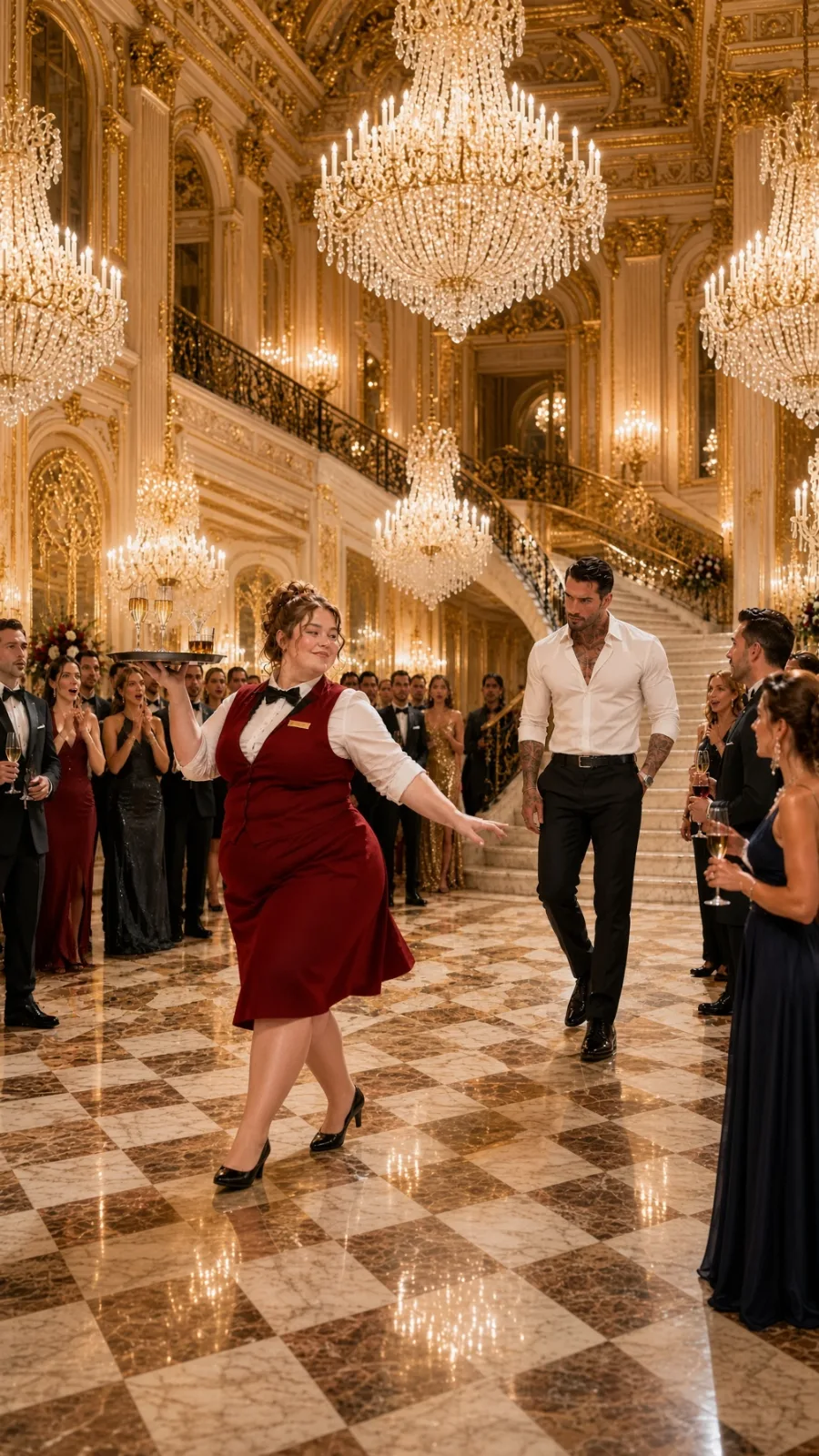
For a moment the ballroom disappeared, replaced by the warmth of his hands and the sound of his patient laughter whenever she stepped on his shoes.
Emily continued walking, but her body answered the music before her mind could stop it.
Her left foot glided sideways, her right foot closed with perfect control, and she turned around a passing waiter without disturbing a single glass.
The movements were small, almost hidden beneath the duties of service, yet every step landed exactly on the beat.
She did not realize that Alessandro had stopped speaking in the middle of a conversation to watch her.
He observed her for nearly a minute, his gray eyes narrowing with concentration, because he had attended enough formal events to recognize trained movement, and what Emily was doing was not imitation or clumsy enthusiasm.
Her posture changed whenever the melody rose, her shoulders relaxed, and a confidence appeared in her face that had not been there moments earlier.
She seemed to become another woman, someone who belonged beneath the chandeliers rather than beside the kitchen doors.
When the song ended, Emily caught herself standing in a dancer’s finishing position with one foot pointed behind her, and embarrassment rushed through her so quickly that her cheeks turned red.
She immediately lowered the tray, hoping no one had noticed.
Alessandro stepped away from the group surrounding him and crossed the ballroom, and conversations weakened as guests realized their host was approaching a member of the serving staff.
“Who taught you to dance?” he asked, and his voice was deep and calm but carried far enough for the nearest tables to hear.
Emily looked over her shoulder, briefly believing he must be speaking to someone else, and when she met his eyes her breath caught.
She had heard stories about Alessandro Moretti all her life, stories of men losing businesses after deceiving him and officials changing their decisions after a single private meeting.
Yet standing before her he did not appear angry.
He appeared curious, which somehow frightened her more.
“My father,” she answered softly.
Alessandro glanced at the tray in her hands and then back at her face. “Was he a professional?”
Emily swallowed and shook her head. “No, sir. He repaired railway engines, but he loved ballroom dancing, and when I was little he taught me everything he knew.”
The room had grown quieter, and Emily became painfully aware of jeweled women studying her uniform and wealthy men suppressing amused smiles.
She wanted to excuse herself, but Alessandro’s attention held her in place.
He asked why she had stopped dancing, and the question opened a wound she had spent twelve years trying to close.
Emily explained that she had won several children’s competitions and that her father had planned to enroll her in a respected dance academy when she turned thirteen.
Three months before the entrance examination he was killed in a traffic accident while returning from a night shift.
Without his income the family lost their apartment, sold nearly everything they owned, and used the last of their savings for her mother’s medical care.
“After that there was no academy,” Emily said, forcing a small smile that did not reach her eyes. “There was only work.”
She did not mention the shoes she kept in a box beneath her bed, or the nights she listened to old music through headphones so her mother would not hear her crying.
Alessandro studied her in silence, because he knew what it meant for a single death to alter the direction of an entire family, and he recognized the practiced resignation in her expression.
It was the look of someone who had stopped asking life for anything because disappointment had become too expensive.
Behind him a silver-haired businessman named Harold Bennett gave a quiet laugh.
Harold was a thin, narrow-faced investor in his sixties whose polished manners concealed a lifelong habit of mocking anyone he considered socially inferior.
“A touching story,” he murmured to the woman beside him. “But childhood lessons hardly make a dancer.”
Several guests smiled, and Emily’s old instinct urged her to retreat.
Alessandro turned his head just enough to silence Harold with a single look, then faced the orchestra and lifted one hand.
The musicians stopped preparing their next song.
Alessandro walked toward the open floor and extended his hand to Emily in full view of the ballroom, and confusion moved through the guests like a breeze.
“Play the waltz again,” he ordered.
The conductor hesitated only a second before raising his baton.
Alessandro looked directly at Emily and spoke with the same measured certainty he used when closing contracts worth millions.
“If you can dance this entire waltz with me,” he said, “I will fund the rest of your life.”
For one suspended moment no one reacted, and then laughter broke out among the guests, soft at first and then louder, because they assumed the feared Alessandro Moretti was making an elegant joke at a waitress’s expense.
Emily stared at his open hand and knew that accepting could end in humiliation, dismissal, or both.
But beneath the fear something long buried began to move, and it was not confidence exactly.
It was memory.
She placed her tray on a nearby table, wiped her damp palm against her skirt, and stepped onto the dance floor.
“All right,” she whispered. “I’ll dance.”
Alessandro closed his hand around hers as the orchestra began, and his other hand settled respectfully at her back.
Emily heard her father’s voice inside her mind counting the first measure.
One, two, three.
She stepped forward, and Alessandro followed.
The laughter faded before they completed the first turn.
Emily’s body remembered what grief had tried to erase, and each movement became stronger, smoother, and more certain.
She crossed the floor with astonishing lightness, her service dress circling her ankles while Alessandro guided her through sweeping turns beneath the chandeliers.
He was an experienced dancer, disciplined and precise, but even he began adjusting to her rather than leading her.
Emily forgot the watching faces, the uniform, and the years she had spent apologizing for occupying too much space.
For the length of the waltz she was twelve years old again, safe in her father’s arms and moving toward a future that had not yet been taken away.
The final notes softened, and Alessandro turned Emily once more, caught her hand, and brought them to a flawless stop at the center of the ballroom.
Silence followed.
Emily stood breathless, her cheeks flushed and her eyes shining with tears she refused to let fall.
Alessandro did not smile broadly, but something in his severe expression had changed.
Before he could speak, one person began to clap, and another joined, and then another, until every guest in the ballroom rose from their chairs.
The applause swelled beneath the chandeliers, powerful enough to drown out the rain against the windows, while Emily remained beside Alessandro Moretti, stunned by the sound of an entire room finally seeing her.
The applause from the previous evening still echoed through Chicago’s newspapers when the sun rose over the city.
Headlines speculated about the mysterious dance between the city’s most powerful man and an unknown waitress, while television commentators argued over whether Alessandro Moretti’s extraordinary promise had merely been a dramatic gesture meant to entertain wealthy donors.
Emily Carter, however, woke before dawn in the tiny apartment she shared with her mother, convinced that sooner or later reality would erase the miracle she had experienced.
She carefully folded her waitress uniform, prepared breakfast for her mother, and silently replayed every second of the waltz, wondering whether she had imagined the sincerity she thought she had seen in Alessandro’s eyes.
Her mother, Margaret Carter, was a gentle fifty-six-year-old woman with silver beginning to spread through her chestnut hair long before old age should have claimed it.
Years of chronic heart disease had left her physically fragile, yet her warm smile still carried the quiet strength that had kept both of them alive after her husband’s death.
She noticed the distant look in Emily’s eyes but simply squeezed her daughter’s hand, believing hope was sometimes too delicate to question aloud.
At precisely nine o’clock that morning a sleek black sedan stopped outside the aging apartment building, and the driver stepped out first, followed by Victor Hale, Alessandro Moretti’s chief legal adviser.
Victor was sixty-three years old, tall and lean, with neatly combed gray hair, sharp blue eyes behind thin rectangular glasses, and the calm posture of a man who had spent four decades negotiating impossible situations without ever raising his voice.
His reputation throughout Chicago extended far beyond the Moretti organization, because he had successfully transformed countless family businesses from questionable operations into respected corporations.
Every movement reflected patience rather than intimidation, making him one of the few people who could speak honestly to Alessandro without fear.
Emily opened the apartment door expecting another bill collector or hospital representative, but instead found Victor standing politely in the hallway holding a leather portfolio.
“Miss Carter,” he said with a respectful nod. “Mr. Moretti asked me to deliver something personally. He instructed me to remind you that he has never broken a promise.”
Emily followed Victor to the Moretti Foundation headquarters in downtown Chicago, assuming she was about to receive a financial settlement large enough to change her life overnight.
Instead she entered a spacious conference room overlooking Lake Michigan, where Alessandro was already waiting beside a long table covered with carefully organized documents.
He wore a crisp white dress shirt with the sleeves rolled to his forearms, revealing intricate black tattoos that disappeared beneath the fabric, and his expression remained composed as always, but there was unmistakable purpose behind every movement.
Rather than sliding a check across the table, Alessandro invited Emily to sit while Victor explained the contents of the legal documents.
A new charitable organization had been established overnight under the name the Emily Carter Arts Scholarship Foundation.
The foundation would permanently finance Emily’s education while also creating annual scholarships for disadvantaged children pursuing dance and performing arts.
Every legal structure had already been completed, every financial guarantee secured, and every asset protected from future manipulation.
Emily stared at the paperwork in disbelief before looking toward Alessandro.
“You promised to fund my life,” she whispered. “This is much more than money.”
Alessandro folded his hands calmly. “Money disappears,” he replied. “Opportunities multiply. I promised you a future, not temporary comfort.”
Before Emily had enough time to absorb the magnitude of the decision, another visitor entered the conference room.
Rebecca Sterling, widely recognized as America’s most accomplished ballroom dance instructor, walked inside carrying a slim leather notebook.
Rebecca was forty-eight years old, tall and remarkably athletic despite decades of demanding choreography, with blonde hair tied into a practical ponytail and green eyes that remained constantly observant.
Her confident posture reflected someone who had spent an entire career correcting the smallest imperfections in world-class dancers.
Twenty years earlier she had suffered a devastating knee injury moments before qualifying for the World Dance Championships, forcing her retirement at the peak of her career.
Rather than allowing bitterness to define her life, she dedicated herself to developing elite dancers, eventually coaching numerous international champions.
Rebecca examined Emily quietly before offering a warm smile that immediately eased some of the younger woman’s anxiety.
“Mr. Moretti asked me only one question yesterday,” Rebecca said. “If someone loses twelve years of training, can talent survive? My answer was yes. Today I’d like to see whether I was right.”
The following weeks transformed Emily’s life into a carefully balanced routine unlike anything she had ever imagined.
Every morning began with ballroom technique under Rebecca’s demanding supervision, where forgotten instincts slowly awakened beneath disciplined repetition.
Every afternoon brought language lessons taught by Professor Daniel Brooks, a soft-spoken linguistics expert in his early fifties whose curly dark hair had already begun turning gray from decades spent teaching diplomats and international executives.
Daniel believed language reflected respect, insisting that confidence came not from sounding impressive but from making others feel understood.
After language classes came communication training, public speaking, stage presence, media interviews, etiquette, and finally introductory business management designed to prepare Emily for responsibilities she had never expected to carry.
Alessandro had deliberately assembled specialists from different fields because he refused to develop only her dancing.
He intended to build a woman capable of standing confidently before any audience in the world without depending on anyone else’s reputation.
Despite the extraordinary opportunities surrounding her, Emily quietly refused to abandon the life that had shaped her.
Three evenings every week she returned to the same neighborhood restaurant where she had worked before the gala, tying the familiar black apron around her waist and greeting regular customers with the same sincere smile.
Her manager repeatedly encouraged her to resign, insisting she no longer needed the income, yet Emily politely declined.
Every paycheck still helped purchase her mother’s medication, but the reason reached much deeper than finances alone.
She feared that accepting complete dependence on Alessandro, regardless of his kindness, would slowly erase the independence her father had worked so hard to teach her.
Washing tables, carrying heavy trays, and serving ordinary families reminded her that dignity came from honest work rather than expensive opportunities.
The restaurant staff watched her with growing admiration because fame had changed neither her humility nor her willingness to help younger employees during busy evenings.
Unknown to Emily, Alessandro occasionally visited the restaurant without entering the dining room.
His black sedan would remain parked discreetly across the street while he reviewed business reports in the backseat, allowing himself brief moments to observe through the large front windows.
He watched Emily laughing with elderly customers, patiently comforting a frightened child after spilling orange juice, and quietly replacing a homeless veteran’s meal without telling anyone she had paid for it herself.
None of those acts attracted cameras or applause.
She behaved exactly the same whether people recognized her from the gala or treated her as an ordinary waitress, and Alessandro had spent much of his adult life surrounded by individuals who became generous only when influential eyes were watching.
Emily possessed something entirely different, because her compassion required no audience.
One rainy evening Rebecca completed another exhausting training session before finally dismissing Emily for the day, and as the young woman hurried toward the bus stop instead of accepting the luxury car waiting nearby, Alessandro remained standing beside the studio window.
Rebecca joined him silently, crossing her arms while watching Emily disappear into the rain carrying nothing more than an old backpack and a worn umbrella.
“Most people would have quit working the moment you created that foundation,” Rebecca observed quietly.
Alessandro nodded without taking his eyes off the street below. “That’s exactly why I didn’t give her money,” he answered. “Character can’t be purchased. It only reveals itself when people finally have the freedom to choose.”
Rebecca smiled faintly because she realized her powerful employer was no longer evaluating Emily’s talent alone.
Day after day, without saying a word, Alessandro found himself respecting her resilience more deeply than he had ever expected, quietly recognizing that the greatest strength she possessed had nothing to do with dancing at all.
Several months passed and Emily Carter’s name slowly began appearing in places she had never imagined.
Local ballroom competitions became regional championships, and regional victories gradually opened the doors to national events where professional judges evaluated every movement with unforgiving precision.
At first audiences came out of curiosity because they remembered the story of the waitress who had danced with Alessandro Moretti.
Soon, however, the whispers changed.
Spectators no longer discussed the gala or the powerful man who had funded her education, because they talked about Emily’s extraordinary musicality, her flawless timing, and the rare emotional honesty she brought to every performance.
She was still a young woman with a soft plus-size figure, warm hazel eyes, and the same gentle smile she had carried while serving meals in a neighborhood restaurant, but something inside her had changed.
The frightened waitress who once apologized for taking up space had gradually become an artist who belonged beneath the spotlight without ever demanding attention.
Every competition strengthened her confidence, yet she remained remarkably humble, thanking every stage assistant, every volunteer, and every musician before leaving the ballroom.
The growing attention surrounding Emily inevitably attracted people who cared less about her talent than her commercial value, and among them was Maxwell Pierce, the charismatic president of Aurora Entertainment Group, one of the country’s largest performing arts management companies.
Maxwell was fifty-one years old, tall and impeccably dressed, with perfectly silver hair, expensive tailored suits, and a polished smile that made investors trust him within minutes.
Behind that charming appearance, however, hid a calculating businessman who had built his fortune by signing young performers before they understood the true worth of their own careers.
Fifteen years earlier, after nearly losing his company during an economic recession, Maxwell had abandoned every ideal he once claimed to believe in.
Since then every artist had become a financial asset rather than a human being.
When he watched Emily dominate another prestigious competition in Chicago, he saw not a gifted dancer but an opportunity capable of generating millions of dollars.
Within days Aurora Entertainment invited Emily to its luxurious headquarters overlooking downtown Chicago, a building that reflected success with marble floors, towering glass walls, and enormous photographs of internationally famous performers decorating every corridor.
Emily had never entered an office so magnificent before, and she nervously adjusted the sleeves of her modest cream-colored blouse while trying to ignore the portraits of celebrities who smiled confidently from every wall.
Maxwell personally welcomed her with remarkable warmth, praising her performances and insisting that America had never seen a dancer quite like her.
He spoke with practiced sincerity, describing international tours, television appearances, magazine covers, sponsorships, luxury apartments, and financial security beyond anything Emily had ever imagined.
After years of struggling to afford groceries and medicine for her mother, the future he described sounded almost unreal.
By the end of the meeting Maxwell placed a thick contract before her and assured her that signing it would transform her life forever.
Emily carefully read only the first several pages before becoming overwhelmed by the legal terminology.
Everything seemed generous, because Aurora would cover travel expenses, costume design, marketing campaigns, professional partnerships, and worldwide promotion, and the salary alone exceeded anything she had believed possible.
For a young woman who had spent most of her adult life worrying about rent and hospital bills, the offer felt less like a business agreement and more like salvation.
She politely asked for a day to consider the proposal, but Maxwell gently encouraged her to sign immediately, explaining that international opportunities moved quickly and hesitation often cost promising careers.
His reassuring tone gradually dissolved her uncertainty.
By the time she returned home that evening she had almost convinced herself that accepting the contract would finally allow her to repay Alessandro for everything he had done while providing complete financial security for her mother.
The following afternoon Emily visited the Moretti Foundation carrying the contract inside her handbag, intending only to inform Alessandro of her decision before signing.
Alessandro listened quietly while she enthusiastically described Aurora’s promises, then accepted the document without offering immediate opinion.
Instead of reading it himself, he handed it directly to Victor Hale.
The experienced attorney adjusted his glasses and slowly turned each page, his calm expression becoming increasingly serious as the minutes passed.
The conference room remained silent except for the sound of paper sliding across polished wood.
Emily noticed Victor re-reading several paragraphs before taking detailed notes beside obscure legal clauses hidden deep within the contract.
Alessandro watched his attorney rather than Emily, understanding from decades of experience that dangerous agreements rarely revealed themselves through obvious language.
Finally Victor closed the document and removed his glasses with visible disappointment, and his normally gentle voice carried unusual firmness as he explained what Emily had nearly agreed to.
Aurora Entertainment was not offering a partnership.
The company was demanding complete ownership over every professional decision she would make for the next fifteen years.
Emily would require written permission before accepting competitions, interviews, charitable appearances, teaching opportunities, or even social media activity.
Every dance she choreographed, every photograph taken during performances, every broadcast, and nearly every dollar generated by her career would legally belong to Aurora.
Even if she wished to retire or pursue independent projects, the financial penalties were intentionally impossible to overcome.
Victor quietly summarized the reality in one sentence.
“You would no longer own your career. You would become their product.”
Emily felt her stomach tighten as she slowly realized how close she had come to surrendering the future Alessandro had worked so hard to protect.
She remembered Maxwell’s reassuring smile and suddenly understood why every conversation had focused on opportunity instead of freedom.
Embarrassment quickly replaced excitement, and she lowered her eyes and admitted that she had almost signed the agreement without asking anyone else to examine it.
Alessandro remained silent for several moments before standing and walking toward the enormous windows overlooking Chicago.
The afternoon sunlight reflected across the skyline as he folded his hands behind his back, recalling countless businessmen who had attempted similar tactics throughout his own career.
He had witnessed ambitious young people sacrificing decades of their lives because someone offered immediate success wrapped inside complicated legal language.
Without turning around he spoke quietly enough that Emily almost missed the words.
“Talent is not meant to be sold cheaply.”
When Alessandro finally faced her again there was neither anger nor disappointment in his expression.
Instead there was the calm certainty of someone who had already reached a decision.
He informed Emily that she would reject Aurora’s proposal entirely.
Rather than allowing a corporation to manufacture her reputation, he would finance her participation in the world’s most respected international ballroom competitions as an independent competitor.
She would choose her own teachers, her own choreography, her own schedule, and eventually her own future.
The Moretti Foundation would provide logistical support only when requested, while every achievement would remain entirely hers.
Emily stared at him in disbelief because she had expected another lecture about caution, not an even greater opportunity.
Alessandro simply reminded her that independence demanded more patience than celebrity, but genuine respect could never be purchased through advertising campaigns.
The months that followed proved his words correct.
Emily entered prestigious competitions across Europe and North America, representing no entertainment company, no commercial brand, and no corporate sponsor beyond the educational foundation that bore her own name.
At first judges and competitors underestimated her because she arrived without expensive publicity or elaborate promotional teams.
Yet once the music began, assumptions disappeared.
Performance after performance Emily earned high scores through technical excellence, emotional authenticity, and relentless discipline rather than aggressive marketing.
Fellow dancers who had initially dismissed her gradually began seeking her advice during rehearsals, while respected coaches complimented not her unusual story but the undeniable quality of her dancing.
For the first time in her life applause no longer belonged to the waitress who had once danced with Alessandro Moretti.
It belonged entirely to Emily Carter, an independent artist whose talent had finally become impossible to ignore.
Winter arrived in New York with a sharp wind that swept between the skyscrapers and carried the excitement of the International Grand Ballroom Championship, one of the most prestigious dance competitions in the world.
Competitors from more than thirty countries filled the magnificent Lincoln Arts Center, where glittering chandeliers illuminated polished wooden floors that had witnessed generations of legendary performances.
Every participant dreamed of standing beneath those lights, knowing that a single flawless performance could change an entire career.
Emily Carter walked through the grand entrance carrying her dance shoes in one hand, feeling both awe and quiet determination.
At twenty-four she still possessed the same soft plus-size figure, fair complexion, expressive hazel eyes, and gentle smile that had first caught Alessandro Moretti’s attention months earlier.
Yet beneath that familiar appearance now lived a disciplined artist who had survived countless hours of relentless practice, painful self-doubt, and the constant pressure of proving that talent could exist in a body the world refused to celebrate.
The backstage preparation rooms buzzed with nervous energy as dancers stretched, rehearsed difficult combinations, and adjusted elaborate costumes beneath bright mirrors.
Emily noticed immediately that nearly every female competitor fit the traditional image expected by international ballroom judges, remarkably slender with long graceful limbs, elegant necklines, and carefully sculpted physiques that seemed designed for magazine covers as much as for dancing.
Among them stood Natalia Volkov, a twenty-seven-year-old Russian champion whose striking beauty had made her one of the competition’s biggest stars.
Natalia possessed icy blue eyes, platinum blonde hair secured into an immaculate bun, and the confident posture of someone who had spent her entire life hearing she was born to perform.
Years earlier she had won multiple European championships before suffering a disappointing Olympic qualification defeat that hardened her competitive instincts.
She rarely intended to hurt others, but years of living inside an intensely judgmental profession had taught her to believe appearance and excellence naturally belonged together.
As competitors prepared for the opening ceremony, whispered conversations gradually shifted toward Emily.
Some recognized her from international events, while others remembered the widely publicized story of the waitress whose education had been funded by Alessandro Moretti.
At first the comments sounded harmless, but curiosity slowly transformed into mockery.
A few dancers glanced toward Emily before exchanging amused smiles, convinced that someone with her body could never truly belong at the highest level of ballroom competition.
One competitor quietly laughed that she looked more like a costume assistant than a finalist, and another suggested that judges would probably remember her performance only because she looked different from everyone else.
Finally one voice rose just loudly enough for Emily to hear clearly.
“She’s too fat to stand on that stage.”
The sentence was followed by restrained laughter that spread through the dressing room before disappearing into uncomfortable silence.
No one defended Emily, and no one challenged the remark, because most simply lowered their eyes and pretended not to have heard it.
Emily quietly turned away and walked into an empty practice hallway where large windows overlooked the gray Manhattan skyline.
For months she had convinced herself that results mattered more than appearances, but hearing those words inside the world’s greatest competition reopened wounds she thought had finally healed.
Every childhood memory returned with painful clarity.
She remembered classmates refusing to choose her as a dance partner, strangers whispering cruel jokes when she entered studios, and instructors politely suggesting she might enjoy another hobby more suitable for her body.
Success had changed newspaper headlines, yet it had not erased the prejudice waiting beneath them.
Standing alone beside the cold glass, Emily stared at her reflection and suddenly saw not the accomplished dancer she had become but the insecure waitress who had once believed invisibility was safer than hope.
For the first time since meeting Alessandro she seriously considered withdrawing before the competition even began, because losing on stage seemed easier than enduring another public humiliation.
Alessandro Moretti had accompanied the delegation to New York, although he deliberately remained far from the cameras.
At forty-two his commanding presence drew attention wherever he walked even without security surrounding him.
His powerful athletic frame, neatly combed dark hair, sharp jawline marked by faint stubble, and calm gray eyes projected the disciplined confidence that had allowed him to transform one of America’s most feared criminal organizations into a legitimate business network.
While organizers focused on celebrities and sponsors, Alessandro quietly observed the backstage area from a distance until he noticed Emily standing alone near the practice corridor.
He immediately recognized the subtle changes in her posture, because her shoulders had lowered, her breathing had become shallow, and the confidence she had built through months of disciplined work seemed to be slipping away beneath invisible weight.
He approached without rushing and stood beside her, looking through the same window toward the city rather than directly at her reflection.
Emily tried to hide the tears gathering in her eyes, embarrassed that a few careless words had shaken her so deeply after everything she had already overcome.
She admitted she was afraid the audience would see only her size before noticing a single step she danced.
Alessandro remained silent for several moments because he understood that encouragement offered too quickly often sounded empty.
Finally he turned toward her with the same calm expression she had first seen on the ballroom floor in Chicago.
“The day I met you,” he said quietly, “I only saw talent.”
Nothing more followed.
There was no long speech, no elaborate motivation, and no promise that victory was guaranteed.
The simplicity of those words carried far greater power because Emily knew they were true.
On the night of the charity gala, before the scholarships, before the championships, before the newspapers had learned her name, Alessandro had already believed in the dancer hidden beneath the waitress’s uniform.
Those words settled deep inside Emily’s heart as she slowly closed her eyes.
She realized she had spent months trying to convince other people she deserved to stand beside them when the only opinion that truly mattered had never changed from the beginning.
She was not dancing to silence critics.
She was dancing to honor her father, repay Alessandro’s faith, and prove to herself that dreams delayed were not necessarily dreams destroyed.
When the stage manager announced her performance, Emily inhaled once, adjusted the elegant ivory ballroom gown designed specifically for the championship, and walked confidently toward the brilliant lights waiting beyond the curtains.
Every step felt lighter than the one before because she no longer carried the impossible burden of seeking everyone’s approval.
The orchestra began with the opening measures of a classic Viennese waltz, and the enormous auditorium gradually disappeared from Emily’s awareness.
Her movements flowed with remarkable elegance, blending flawless technique with genuine emotion that reached far beyond technical perfection.
Each turn reflected years of discipline, every extension carried quiet confidence, and every expression revealed a woman who had finally accepted herself completely.
Judges who had entered the evening expecting another well-trained competitor found themselves captivated by something far rarer than flawless choreography.
Emily danced with unmistakable authenticity.
She was no longer performing for trophies or applause, because she was telling the story of every dream that had survived ridicule long enough to become reality.
When the final note echoed through the theater, silence filled the auditorium for a heartbeat before thousands of spectators rose simultaneously from their seats.
The applause erupted like thunder beneath the soaring ceiling, growing louder instead of fading.
Minute after minute the standing ovation continued as judges exchanged astonished glances and fellow competitors applauded with sincere admiration.
Even Natalia Volkov stood with genuine respect, realizing she had witnessed not simply technical excellence but extraordinary courage expressed through dance.
Moments later the chief judge stepped onto the stage and announced the official results.
Emily Carter had won the International Grand Ballroom Championship.
As tears finally filled her eyes beneath the brilliant stage lights, the audience continued applauding for nearly ten uninterrupted minutes, celebrating a victory earned not because she had looked like every other dancer but because no one else could dance quite like her.
One year after Emily Carter lifted the championship trophy in New York, the first warm days of autumn returned to Chicago, bringing golden sunlight across the city where her remarkable journey had begun.
Standing on the east side of Lincoln Park was a beautiful three-story building surrounded by maple trees whose leaves had just begun turning crimson and gold.
Above its entrance hung a simple bronze sign that read Emily Carter Dance Academy.
Long before the official opening ceremony, children and families had already gathered outside the gates, filling the courtyard with nervous excitement and hopeful laughter.
Some arrived wearing brand new dance shoes purchased after months of saving, while others carried worn-out sneakers carefully cleaned the night before because they could afford nothing else.
They came from every neighborhood in Chicago, united by a dream that once seemed too expensive or too impossible to pursue.
Emily stood near the entrance greeting every family personally instead of waiting inside as the guest of honor.
At twenty-five she remained the same warm-hearted woman who had once carried silver trays through a charity gala, although confidence now rested naturally within her gentle smile.
Her soft plus-size figure had never changed, nor had the kindness reflected in her hazel eyes, but years of disciplined training and international success had transformed the quiet waitress into a graceful woman whose presence inspired trust before she spoke a single word.
She deliberately chose a simple ivory dress instead of an expensive designer gown because she wanted every child entering the academy to see someone who looked approachable rather than untouchable.
As each nervous student arrived, Emily knelt whenever necessary to greet them at eye level, remembering exactly how frightening it felt to believe everyone was judging appearances before talent.
One of the first children to enter was eleven-year-old Sophie Martinez, a shy girl with curly black hair, freckles across her cheeks, and a noticeably fuller figure than most girls her age.
Sophie clung tightly to her mother’s hand while staring anxiously at the other students warming up inside the studio.
She had loved dancing since preschool but had quit two different classes after classmates repeatedly laughed at her body during rehearsals.
Her mother, Elena Martinez, was a hard-working nurse in her late thirties with tired brown eyes that reflected years of balancing hospital shifts and single parenthood after losing her husband to cancer.
Elena had nearly cried when she learned that Emily’s academy accepted every child regardless of appearance or financial background.
Emily immediately recognized the uncertainty in Sophie’s expression because she had once worn the same look herself.
Kneeling beside the young girl, she smiled gently and said, “Inside these walls, nobody has to earn the right to dream. You already belong here.”
Sophie smiled for the first time that morning before carefully stepping through the front doors.
The academy itself represented far more than a dance school.
During the previous year Alessandro Moretti had quietly expanded the Emily Carter Arts Scholarship Foundation far beyond its original purpose.
Scholarships now covered tuition, transportation, dance wear, music education, and nutritional support for hundreds of children whose families could never have afforded professional artistic training.
Several former scholarship recipients had already won regional competitions, while others simply discovered confidence they had never believed possible.
Classrooms were equipped with mirrors, rehearsal studios, libraries, language learning spaces, and counseling rooms because Emily insisted that artists needed emotional support as much as technical instruction.
Every hallway displayed photographs not of famous celebrities but of ordinary children smiling during lessons, reminding everyone that success began with opportunity rather than perfection.
The opening ceremony brought together community leaders, teachers, scholarship recipients, families, and countless supporters who had followed Emily’s extraordinary journey from the beginning.
Alessandro Moretti arrived without the extravagant entrance many expected from Chicago’s most influential businessman.
At forty-three he remained every bit as commanding as before, with his powerful athletic frame, neatly styled dark hair, sharp features, and calm gray eyes that rarely revealed emotion.
His reputation throughout the city had continued evolving as nearly every remaining Moretti enterprise completed its transition into legitimate business, making him respected as much for his discipline as for his influence.
Yet among the children crowding around the stage Alessandro was not feared, because they knew him simply as the man whose foundation had allowed them to chase dreams their families could never have purchased.
When Emily stepped onto the stage, the applause continued for several minutes before the audience gradually settled into silence.
Looking across the hundreds of children seated before her, she found herself remembering every difficult moment that had brought her there.
She remembered serving food while secretly mourning the dance career she believed had died with her father.
She remembered standing alone backstage in New York wondering whether she deserved to perform.
Most vividly she remembered the evening Alessandro had extended his hand across a ballroom floor and offered a promise no one else believed.
Her voice trembled slightly as she turned toward him.
“If you hadn’t kept your promise that day,” she said softly, “I would still be a waitress.”
The audience remained completely silent because everyone understood those words carried far greater meaning than professional success.
Emily was not ashamed of her former work.
She simply recognized how one act of faith had completely changed the direction of her life.
Alessandro stood slowly and walked toward the podium, and he looked at Emily for several quiet moments before answering with the same calm honesty that had always defined him.
“No,” he said gently. “That day I only opened the door.”
He paused briefly, allowing his words to settle throughout the auditorium before continuing.
“You were the one brave enough to walk through it.”
No elaborate speech followed, and none was necessary.
The children listening understood immediately that greatness did not begin when someone offered help.
It began when someone found the courage to accept the opportunity and continue moving forward despite fear.
Emily lowered her head as tears quietly filled her eyes, knowing those simple words described her journey more truthfully than any newspaper article ever could.
Life at the academy flourished over the following months.
Every afternoon echoed with music, laughter, determined practice, and countless small victories that mattered far more than trophies.
Children who had once hidden at the back of classrooms gradually volunteered to perform before audiences.
Students from wealthy families practiced beside those who had arrived wearing secondhand shoes, and no one cared which background anyone came from once the music began.
Emily taught every class herself at least once each week because she wanted every student to understand that the academy’s founder still believed hard work mattered more than titles.
Alessandro visited frequently but never interfered with the