Michael Jackson Without Makeup… The Footage They Tried To Hide
For years, people looked at Michael Jackson’s changing appearance and believed they could read his entire identity from his face.
A photograph became an accusation.
A patch of pale skin became a punchline.
A new hairstyle became another headline.
Yet behind those images was a medical condition Jackson eventually described himself.
A painful scalp injury that left lasting effects, and a team of people trying to make his skin and hair look consistent under unforgiving lights.
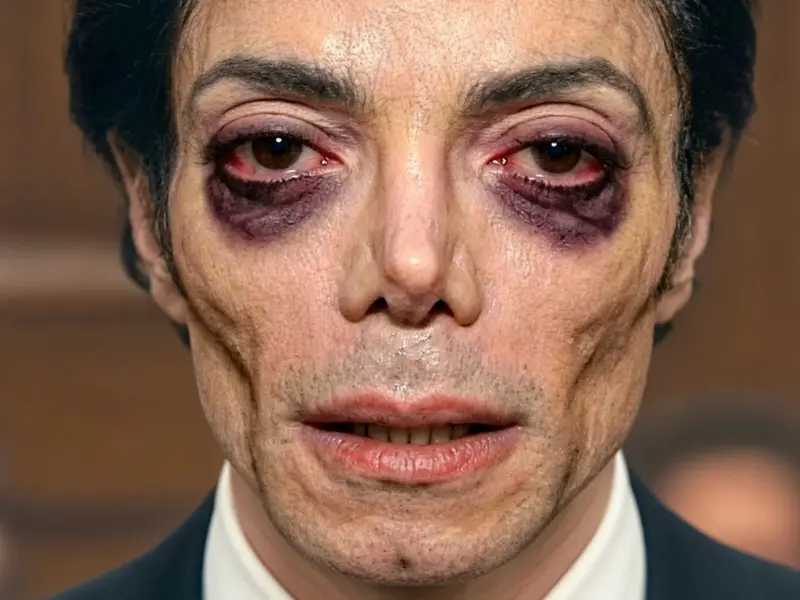
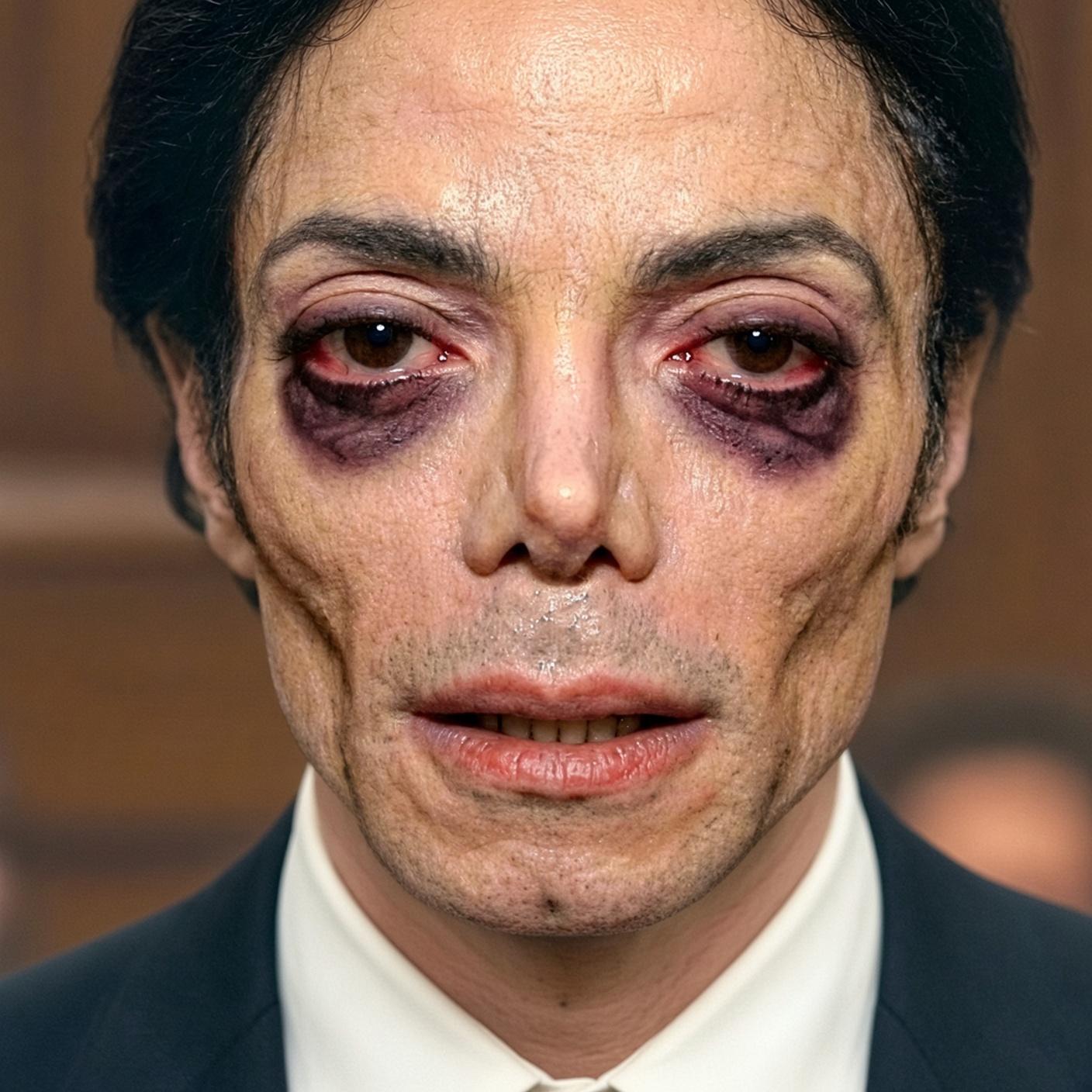
The footage often shared online as “Michael Jackson without makeup” can feel startling, but not because it reveals a secret conspiracy.
It reveals something simpler and more human.
The public spent years judging an appearance without understanding what was happening to it.
The story begins with a question that followed Jackson for decades.
Why had his skin become so much lighter than it was when he was young?
In 1993, during his televised interview with Oprah Winfrey, Jackson answered directly.
He said he had a skin disorder that destroyed pigmentation and that makeup helped even out the blotches.
Years later, the medical examiner’s findings and testimony from people who treated or worked with him supported the fact that he had vitiligo.
The condition was not an internet rumor or a theory invented by fans after his death.
It was part of his documented medical history.
That does not mean every image of Jackson tells us exactly how the condition affected him at that moment.
Lighting, makeup, clothing, camera quality, and the stage setting all change what a viewer can see.
A rehearsal clip may show patches more clearly than a televised performance.
A deposition photograph may reveal areas normally covered by makeup.
A low-resolution video cannot by itself diagnose a disease or establish why a particular choice was made.
The reliable story comes from combining the images with Jackson’s own statements, medical reporting, autopsy findings, and testimony from people who knew his health history.
Michael Joseph Jackson was born on August 29th, 1958, in Gary, Indiana.
He was the seventh of nine children in a family whose musical ambitions eventually took them far beyond their small home.
As a child, he performed with his brothers as part of the Jackson 5.
By the end of the 1960s, the group had become a major recording act, and Michael’s voice and stage presence stood out even among talented siblings.
His childhood was unusually public and demanding.
Rehearsal, touring, and recording became central parts of his life long before he was old enough to choose an ordinary path for himself.
As a solo artist, Jackson’s success grew through the late 1970s and early 1980s.
Off the Wall made him a major force in pop music, and Thriller transformed that success into a global phenomenon.
His videos, costumes, dance moves, and carefully controlled visual style became as recognizable as his songs.
But the more visible he became, the more every change in his appearance attracted attention.
Some of that attention focused on hairstyles and cosmetic procedures.
Some became cruel speculation about his race, health, or motives.
The public often treated his face as a puzzle it had the right to solve, even when the explanations involved personal medical information.
A major physical injury happened on January 27th, 1984, while Jackson was filming a Pepsi commercial at the Shrine Auditorium in Los Angeles.
During a staged performance involving pyrotechnics, sparks ignited his hair.
Jackson continued down the steps for a moment before the extent of the accident became clear.
He was taken to Cedars-Sinai Medical Center and then transferred to Brotman Memorial Hospital’s burn unit.
Contemporary reports said he suffered second-degree burns to his scalp, including a small area of third-degree burns.
The injury was serious, painful, and widely reported at the time.
The accident left more than a shocking piece of footage.
Jackson later underwent treatment and procedures for the burned area of his scalp.
Reports and later testimony described scarring and hair loss, and the autopsy after his death documented frontal balding and hair connected to a wig.
It is inaccurate to claim that the fire instantly left a large hole that made all future hair growth impossible, or that every wig he wore was solely the result of that accident.
The evidence supports a lasting scalp injury and later hair-related procedures, but the exact course of treatment was more complicated than the dramatic versions often repeated online.
Jackson later donated the settlement money from Pepsi to a burn center established in his name.
The experience was physically and emotionally serious, but it does not explain every later change in his appearance.
The scalp injury and the skin condition were separate medical issues, even though they both shaped how he looked and the methods his team used to prepare him for the public.
Jackson’s changing skin tone became one of the most persistent subjects of speculation.
During the February 10th, 1993, interview with Oprah Winfrey, she asked whether he had been bleaching his skin because he did not want to be Black.
Jackson said that was not the case.
He described a disorder that destroyed skin pigmentation, said he could not control it, and explained that makeup helped even out the blotches.
He also said he was proud to be a Black American and that the accusations hurt him.
His answer was not a formal medical consultation, but it was a clear public account of how he understood the change in his appearance.
At the time, Jackson did not name the condition in detail during that part of the interview.
Later medical reporting and testimony identified it as vitiligo.
In vitiligo, the cells that give skin its color, called melanocytes, are lost or stop functioning in affected areas.
The result can be pale patches that vary in size and location.
The American Academy of Dermatology describes vitiligo as an autoimmune disease, meaning the immune system attacks healthy pigment-producing cells.
It is not contagious, and it is not caused by a person choosing to look different.
The condition can affect people of any skin tone, although the contrast may be more visible on darker skin.
Vitiligo also varies from person to person.
Some people develop a few small patches.
Others experience more extensive pigment loss.
The condition may spread over time, and treatment decisions depend on the pattern, the individual’s health, and what the person wants.
There is no single treatment that works for everyone, and current treatments cannot guarantee a permanent cure.
Some patients try to restore pigment, while others choose camouflage makeup, self-tanner, skin dye, or medical depigmentation of remaining darker skin when the condition has become widespread.
These options are personal and medical decisions, not evidence that a person rejects their identity.
Jackson’s dermatologist, Arnold Klein, later discussed the condition publicly.
He said the pigment loss became extensive and that the aim was to make the overall skin tone more even.
In 2013, Debbie Rowe, who had worked in Klein’s dermatology office before she married Jackson, testified during the family’s wrongful death lawsuit that Jackson had vitiligo and discoid lupus.
Rowe said the vitiligo grew progressively worse and that he eventually chose depigmentation because the patches had become difficult to disguise.
Her testimony was a firsthand account of what she understood from their time together, not a complete medical record, but it supports the point that Jackson’s changing skin tone was linked to a documented skin disorder and its treatment.
The word depigmentation can be confusing because it may sound similar to the accusation that Jackson was bleaching himself to become white.
Medically, however, depigmentation can also describe treatment intended to reduce the remaining pigment when vitiligo has already affected a large portion of the skin.
If darker areas remain beside extensive pale patches, a patient may prefer one more consistent tone.
Jackson’s dermatologist said that as the condition progressed, treating the darker areas became a way to even the skin.
That does not establish every treatment he used or every decision he made, but it explains why a simple claim about wanting to be white ignores the medical context.
The other condition discussed by people close to Jackson was discoid lupus, a form of lupus that can affect the skin and may cause inflammation and scarring.
His dermatologist said he diagnosed Jackson with lupus erythematosus, and later testimony addressed the condition.
Lupus and vitiligo are distinct disorders.
They can both affect skin appearance, but it would be an oversimplification to say lupus caused all the discoloration Jackson experienced.
The most firmly documented explanation for widespread pigment loss was vitiligo, while reports about lupus help explain why Jackson also had other dermatological concerns and scalp scarring.
This medical history changes how footage of Jackson’s uncovered skin should be understood.
Some rehearsal clips and behind-the-scenes images show lighter patches on his hands, arms, neck, or face.
Other shots appear more uniform because of makeup, angle, or lighting.
In a deposition or an unguarded moment, Jackson may have less makeup than he wore for a televised performance, but a clip does not prove that all makeup was absent or that no attempt was made to manage the condition.
The strongest evidence does not come from a viral caption claiming that someone has “finally exposed” him.
It comes from the known diagnosis and the fact that he spoke publicly about the disorder decades ago.
The same caution applies to footage from Captain EO, the 1996 deposition, and rehearsals for This Is It.
Clips from different periods are often grouped together online as if they were one newly uncovered revelation.
They are not necessarily from the same production, and their original purposes differ.
Captain EO was a 3D science fiction short film made for Disney theme parks in the 1980s.
A legal deposition is a formal record made for litigation.
This Is It footage documented the rehearsals for Jackson’s planned London concerts in 2009.
These recordings can show aspects of his appearance, but they were not all part of a single hidden archive deliberately withheld from the public.
Calling the footage “the truth they tried to hide” is dramatic, but the phrase implies a coordinated effort to suppress evidence.
There is no need to make that claim for the images to matter.
Some footage was private or never intended for broadcast.
Some appeared in news reports or legal proceedings.
Some has circulated among fans for years.
The fact that a video is grainy or unfamiliar does not mean it was hidden as part of a cover-up.
A more accurate point is that images showing Jackson without the familiar layers of performance makeup can challenge the simplified assumptions people made about his appearance.
Makeup was an important part of Jackson’s work, but it was not unusual for a major performer to rely on it.
Stage lighting can wash out a face, sweat can make products run, and a camera picks up details that an audience in a large arena may never notice.
For someone whose skin tone changed because of vitiligo, makeup also served a practical purpose.
It could reduce the contrast between patches and make the appearance more consistent.
Jackson explained that purpose himself in 1993.
His longtime makeup artist, Karen Faye, later described the work of helping him prepare for performances and maintain the look audiences expected.
In a 2026 interview, Faye made headlines by saying she used a Sharpie marker during performances to define Jackson’s eyes and eyebrows.
She said his eyeliner tattoo had been done incorrectly and that the marker helped her sharpen the look on stage.
She defended the practice by noting that doctors sometimes use marker pens to mark skin before procedures.
Her statement is a recollection of her professional routine, not a recommendation for anyone else.
Permanent markers are not designed as cosmetics, and products used near the eyes can pose irritation or other risks.
The story is striking because it reveals how practical and improvised the small detail of a legendary stage image could be.
That anecdote should not distract from the distinction between makeup for performance and treatment for vitiligo.
The Sharpie story was about the definition of the eyes and eyebrows under performance conditions.
It was not proof that a marker was used to cover the skin condition.
Camouflage makeup foundations and other products were used to even out skin tone, according to Jackson and people who worked with him.
Each technique had a different purpose.
When those details are blended together, it becomes easy to exaggerate the story and make it sound as though every part of his face was being artificially reconstructed for the same reason.
The autopsy report provided another glimpse into Jackson’s appearance, but it also requires careful interpretation.
The report described cosmetic tattoos around his eyebrows and lips and dark pigmentation on the scalp, apparently used to blend the hairline with wigs.
It also recorded depigmentation of skin on the chest, abdomen, face, and arms.
The findings were reported publicly in 2009 and discussed during the 2013 wrongful death trial.
These details were not simply rumor, but they were also private medical information.
They tell us about the appearance of his body after death.
They do not reveal every emotional reason behind each cosmetic procedure or what he privately felt when he looked in a mirror.
The scalp tattoos in particular have often been discussed without context.
The medical examiner described darkened areas that appeared to be tattooed to blend the hairline.
Cosmetic tattooing can create the illusion of color in areas where hair is sparse.
The report also documented hair attached to a wig and frontal balding.
Together with the history of the Pepsi accident and later scalp treatment, these details offer a more grounded explanation for why hairpieces and wigs were part of Jackson’s appearance.
They do not support the theatrical claim that he was “drawing his face back on” every day.
That phrase may sound emotional, but it is an interpretation, not a medical finding.
It is also important to correct another common exaggeration.
The autopsy did not describe Jackson as an emaciated skeleton.
The report recorded his weight at about 136 pounds and height at 5 feet 9 inches, and contemporary reporting said the figure was within an acceptable range for that height.
People who worked with him during the final rehearsals, including Faye, described periods when they believed he looked alarmingly thin or unwell.
Those are relevant witness observations, but they should not be substituted for the medical examiner’s overall assessment.
A responsible account can acknowledge concerns from colleagues while avoiding the claim that an autopsy proved he was skeletal.
What comes through most strongly in the footage and testimony is how much attention Jackson’s appearance attracted and how little privacy he could claim around it.
He was judged for his skin, nose, hair, weight, clothing, and every visible change.
In the 1993 interview, he explained that the stories hurt him and asked why the public focused on his skin instead of his work.
That frustration is understandable.
People with vitiligo already navigate a condition that can change their appearance in unpredictable ways.
When the person affected is a global celebrity, every patch can be photographed, magnified, and discussed as if it were evidence of a hidden motive.
The cruel nickname “Wacko Jacko” became part of the tabloid coverage that framed Jackson as strange or ridiculous.
Some stories about his skin treated him as a punchline instead of a person managing a chronic condition.
The problem was not that people noticed his appearance.
The change was visible.
The problem was that speculation often replaced listening.
Jackson had explained that he had a skin disorder, and medical professionals later confirmed vitiligo.
Still, many discussions continued to treat the diagnosis as an excuse rather than a real part of his health history.
The footage cannot reverse those years of commentary, but it can remind viewers how much was left out when the story was reduced to a headline.
There is no single image that captures all of Jackson.
The videos showing visible patches are not more authentic than the music videos with elaborate makeup.
One records a different context from the other.
A stage performance is designed to create visual effect, while a rehearsal clip may be made for practical review, and a deposition is produced for legal purposes.
Jackson was real in all of those settings.
The fact that he looked different between them does not mean one version was a lie.
It means he was a person whose work, medical needs, and public image overlapped in complicated ways.
For people living with vitiligo, the discussion is not just about a celebrity from another generation.
The condition can affect confidence, social relationships, and the way strangers respond to a person’s appearance.
Some people choose to cover their patches.
Others prefer to let them show.
Neither choice is a measure of courage or shame.
The American Academy of Dermatology notes that makeup, self-tanner, and skin dyes are options for people who want to make patches less noticeable, while medical treatments may help restore pigment in some cases.
These options exist because people deserve to decide how they want to present themselves, not because they owe the public a particular look.
Michael died on June 25th, 2009, at fifty.
In the years since, his image has been examined from every possible angle.
His music, his dance, his family, his health, and the controversies that surrounded him.
The story of his changing skin deserves to be told with the same care given to the rest of his life.
Vitiligo was real.
His scalp injury was real.
The public scrutiny was real.
The makeup and hairpieces were part of how he worked and managed the visible effects of those conditions.
None of that turns him into a perfect person, and none of it makes every question about his life disappear.
It simply replaces a lazy caricature with a more accurate explanation.
When viewers watch a clip in which the patches are visible, what they are seeing is not a final secret or proof of a hidden plot.
They are seeing one moment in a long medical and personal history.
They are seeing a face that was photographed, made up, scrutinized, and misinterpreted for decades.
And they are being reminded that an appearance is not a diagnosis.
A diagnosis is not a person’s entire identity.
And a public figure is still entitled to privacy.
The most important truth is not that the world finally caught Michael Jackson without makeup.
It is that he explained his condition himself, and the facts have been available for years.