A Single Mom Sheltered a Wounded K9—Then Armed Contractors Surrounded Her Farm Before Sunrise
The dog appeared out of nowhere.
A massive shape collapsing onto the center line of a rain-slicked logging road in the dark heart of British Columbia, and Simone Decker nearly drove straight over him.
She stood on the brakes hard.
The old Tacoma fishtailed across the wet asphalt, headlights sweeping wildly through the curtain of rain before the truck shuddered to a stop with maybe two meters to spare.
Simone sat there for a moment, hands white-knuckled on the steering wheel, breathing.
Then she grabbed her emergency flashlight from the glove box and stepped out into the storm.
She was a paramedic—ten years on the road in the interior, working out of a station in the small lakeside town of Coldwater, B.C., where the winters were brutal and the callouts were long, and the nearest trauma center was an hour’s drive in good conditions.
She was used to finding things in the dark that she wasn’t prepared for.
But nothing had prepared her for this.
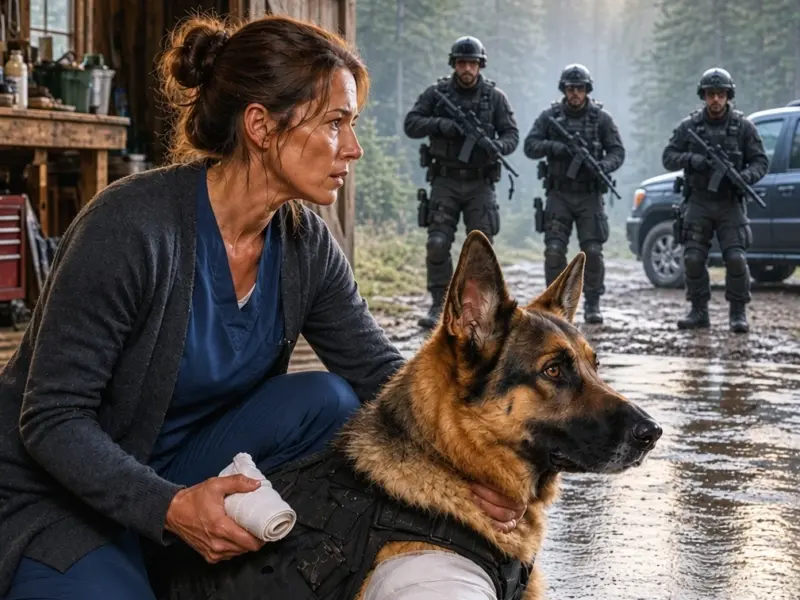
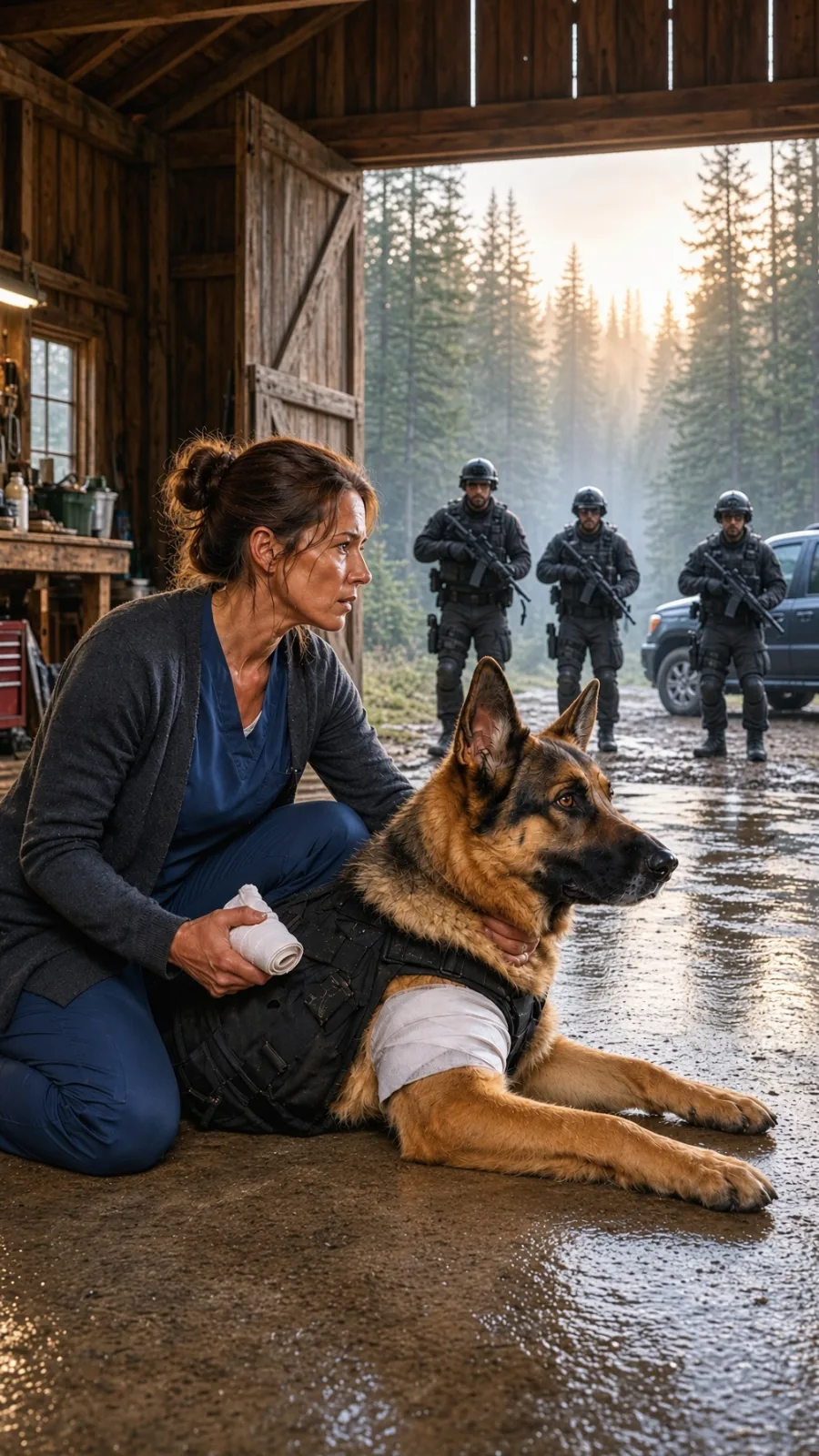
The dog was enormous—a German Shepherd, sable black along the spine, the kind of animal that looked like it had been engineered for violence.
He was lying on his side, ribs heaving, and across his chest and back he wore a heavy tactical vest.
Not a search-and-rescue harness. Not a police K9 patrol vest.
This was military-grade ballistic plating, matte black, with a series of alphanumeric codes heat-stamped into the Kevlar and a bracket on the side where a communication module had once been mounted.
The bracket was empty.
The wiring was torn free at the roots, like someone had ripped it away in a hurry.
Simone crouched in the rain.
Her flashlight found the wound before anything else.
High on his left foreleg, just below the shoulder joint—a clean through-and-through.
Not a hunting accident. The entry was too precise, too small.
A rifle round, something high-caliber and deliberate.
“Hey,” she said quietly. “Hey, okay. You’re okay.”
The dog turned his head and looked at her.
His eyes were a pale honey gold, and what she saw in them was not aggression.
It was exhaustion so profound it looked like surrender—and underneath the exhaustion, the faintest, most desperate flicker of trust.
She did not think beyond that moment.
She got him into the truck.
Simone Decker was thirty-one years old, a single mother to a six-year-old girl named Cass, and she lived in a converted farmhouse eight kilometers outside Coldwater on a gravel road that turned into a mud river every time it rained hard.
Her nearest neighbor was a retired forestry worker four kilometers south who kept to himself.
The property had belonged to her grandmother, had passed to her mother, and had passed again to Simone when her mother died of cancer four years ago—leaving her with a mortgage, two hectares of rocky land, and the sudden, non-negotiable task of raising Cass alone.
She drove those eight kilometers with one hand on the wheel and one hand pressing a folded trauma dressing against the dog’s shoulder where he lay on the folded blankets she’d spread across the back seat.
He made no sound. He didn’t try to bite. He simply breathed.
It was 2:47 in the morning.
Simone pulled around the back of the property to the equipment shed—a large, timber-framed structure she used for storage and repairs, insulated and dry, with overhead fluorescents on a pull-cord switch.
She got the dog inside, onto a canvas tarp, under the heat of the lights.
Then she went to work.
She had a trauma bag in the truck, always.
Ten years running calls in the backcountry meant you kept supplies with you the way other people kept roadside flares.
She had irrigation fluid, sterile packing gauze, a suture kit, local anesthetic cartridges, broad-spectrum antibiotics.
It wasn’t a surgical theater. It was a shed in the Okanagan in a November rainstorm.
But it was enough.
The bullet had passed cleanly through the lateral muscle, missing bone, missing artery.
Whoever shot this dog had been aiming to stop him, not to kill him—or they’d missed and got lucky.
Simone cleaned the wound, packed it, and sutured it with the careful, unhurried hands of someone who had done fieldwork in the dark.
The dog lay still through all of it.
Once, when the anesthetic wasn’t quite deep enough and she had to press into a tender seam, he let out a single low sound.
Not a whimper—more like a held breath released—and then he settled again.
His eyes tracked her the entire time.
When she finished the last suture and straightened up, her back aching, the dog lifted his head and placed his chin gently on her knee.
It was the most eloquent thing she had ever experienced.
She sat with him for a while, listening to the rain on the metal roof.
At some point she noticed the small device still clipped to the back plate of his tactical vest.
A transponder unit, blinking a slow red pulse once every four seconds.
She’d missed it in the chaos of the wound care.
She stared at it for a long moment, thinking about what it meant that a dog in military-grade body armor was lying on the floor of her equipment shed in the middle of nowhere, bleeding from a gunshot wound at three in the morning.
She found a hammer on the workbench and broke the transponder with a single clean blow.
The blinking stopped.
The shed was quiet.
She read the designation from the inside collar panel: K9BR4.
There was a partial call sign below it, partially scorched, partially worn.
*Briar.*
“All right, Briar,” she said softly. “Nobody’s finding you tonight.”
She put the vest aside on the bench.
Then she sat back down beside him on the tarp, pulled a blanket over her shoulders, and stayed.
By six in the morning, the rain had thinned to a fine mist.
Simone heard Cass move upstairs—the familiar pattern of small feet on old floorboards—and slipped back into the house, locking the shed behind her.
Her babysitter, a seventeen-year-old from town named Sophie Caron who sometimes stayed over after late shifts, was already awake and making instant coffee in the kitchen.
Simone paid her for the overnight, thanked her, and watched Sophie’s car crunch down the gravel drive in the fog.
Then she went upstairs and found Cass standing in her doorway in unicorn pajamas, holding her stuffed rabbit.
“Mama, the power went out.”
“I know, love. Come have breakfast.”
She made oatmeal. She watched Cass eat. She checked her phone.
No signal.
She walked to the kitchen window and checked the cell bar indicator again.
Nothing.
She lived here. In five years, through ice storms and mud season and the power outage that lasted three days last February, she had always had at least one bar of service on this ridge.
Always.
She crossed to the router on the side table.
The internet was down, too.
Not the usual flickering amber of a service outage, but a flat, dead, powered-off dark.
The router was still plugged in. The power was still running.
The internet was simply gone.
Simone set her phone face down on the counter.
She breathed slowly, the way she’d been trained to breathe on a high-stress call.
Steady intake, controlled exhale, don’t let the body get ahead of the mind.
“Cass,” she said, her voice completely even. “Finish your oatmeal, and then we’re going to do an indoor day. Movies, blanket fort, the whole thing.”
Cass lit up immediately. “Can we do the fort in the living room?”
“The best one you’ve ever seen,” Simone said.
She got Cass set up with the pile of old DVDs from the bottom cabinet and went back to the kitchen.
She put on her outdoor vest. She picked up the old bolt-action .308 she kept locked in the back closet—legal, registered, one of the few decisions her mother had made that Simone had been grateful for every day since she moved back to this property—and checked the magazine.
She loaded three rounds, then slipped outside through the back door.
The shed door was undisturbed.
She unlocked it and stepped inside.
Briar was not on the tarp.
She found him standing at the far end of the shed, next to the workbench, perfectly still.
His weight settled low, and his ears angled toward the back wall.
The wall faced the tree line sixty meters away—a dense stand of lodgepole pine that ran uphill into Crown land.
He wasn’t growling. He wasn’t making any sound at all.
He was simply watching the wall with an attention so total and concentrated it made the hair on Simone’s arms stand up.
She walked to his side. He pressed his flank against her leg without looking away from the wall.
She picked up the tactical vest from the workbench.
It was heavier than it looked.
She ran her fingers along the inside seam panel and felt it.
A slight rigidity in the lining that didn’t match the surrounding material.
A shape about the size of a thick deck of cards, sewn flush into the inner ballistic layer.
She pressed along the seam with her thumbnail and found the stitching.
Recent, tight, but not factory-done.
Done by someone working quickly with a needle and thread.
Whatever was inside that vest, someone had hidden it there deliberately.
Before she could think further, Briar’s posture changed.
He went from watchful to locked.
Every muscle sudden and rigid, a low tremor running through his frame.
Not a growl—something quieter. A preparation.
Simone went to the narrow side window and wiped the condensation from the glass with her sleeve.
The tree line was forty meters of dim gray morning fog.
She saw nothing.
Then she saw it.
A shape that was slightly too regular, slightly too deliberate in the way it held still against the background of moving mist.
A figure standing at the woods’ edge, wearing full tactical camouflage in a digital gray-green pattern, carrying what looked like a compact suppressed carbine at the low ready.
She kept very still.
Her breath fogged the glass, and she stepped back before it could obscure her view again.
A second figure appeared from the right, moving along the edge of the fence line in a slow, deliberate traverse.
Then a third, emerging from behind the equipment lean-to on the far side of the gravel turnaround.
Three operators, minimum, moving in a coordinated loose wedge.
No insignia she could see. No police markings. No bright yellow sheriff’s or RCMP windbreakers.
These were not her local detachment from Coldwater coming to check on a noise complaint.
These were not search-and-rescue volunteers in high-visibility orange.
The precision of the movement, the gear, the way they used the terrain—she had seen enough calls involving military and special operations personnel over the years to recognize the shape of what was in front of her.
These were trained shooters. Professional.
Operating quietly in the early morning on her private property.
And between her and her house—where Cass was watching cartoons—the three of them had formed a loose arc that covered every obvious approach.
Simone’s mind went cold and clear in the way it always did at a bad scene.
*Stop. Assess. Prioritize.*
The vest and whatever was inside it was secondary.
Cass was in that house. That was the entire equation.
She looked down at Briar. He was watching her.
She pointed to herself, then to the back wall of the shed, then toward the house.
It was not a trained command. She made it up.
But he understood it.
There was a secondary access at the rear of the shed—an old feed-through hatch at ground level, low and rusted, barely large enough for a person to crawl through, opening into a drainage channel that ran along the back of the property under a tangle of overgrown willow scrub.
It faced away from the tree line. It was a blind spot.
She went to it.
She undid the latch with careful hands and eased it open a centimeter at a time.
The hinges were old. They made no sound.
Briar slipped through first.
Despite the sutured shoulder, he moved low and fluid and utterly without noise, belly to the frozen ground.
Simone followed, dragging the .308 through after her, staying flat in the shallow ditch as the cold mud soaked into her vest and jeans.
The fog was their ally here, dense and close.
It reduced visibility to maybe fifteen meters.
They crawled.
The drainage channel angled toward the back corner of the house, coming up behind the root cellar bulkhead on the north wall.
Simone stayed low and moved slow, listening.
Rain dripped from the willows.
Somewhere ahead, a crow startled up from the fence post and was gone.
She was twelve meters from the back door when Briar stopped.
Every muscle locked solid.
He turned his head to the left at an exact ninety-degree angle and went still as stone.
Simone followed his gaze.
Nothing. Fog. The dark bulk of the woodshed to her left.
Then, movement.
A figure stepping around the corner of the woodshed with the smooth, unhurried confidence of someone who has done this hundreds of times.
He was close—ten meters, maybe less. Moving directly toward their position.
He wore a balaclava pulled up. A night-vision rig on a helmet mount, currently stowed up.
He swept his carbine barrel left, right, in a slow, professional arc as he moved.
He was going to walk right into them in approximately four seconds.
Simone raised the .308 and held on his chest, then stopped herself.
She couldn’t fire. The sound would bring every operator on the property down onto her position, and she’d never make the house.
She needed those four seconds to matter differently.
Briar made the decision for her.
He launched from the ditch with no warning sound, no warning bark, no warning of any kind.
He was simply not there, and then he was.
Ninety-odd pounds of muscle and trained intent covering the gap in three silent strides, hitting the operator at chest height and driving him backward into the wall of the woodshed with a contained, muffled impact.
The operator grunted. His carbine angled down, muzzle into the dirt.
Briar’s jaws clamped onto his forearm, locking the weapon down.
Simone was already moving.
She came in from the left and drove the buttstock of the .308 hard against the side of the operator’s helmet.
The sound was a dull, heavy crack.
The man’s knees went. He folded sideways, and Simone caught the carbine as it swung free, pushing the muzzle safe.
Briar held on for one more second, then released on his own, stepped back, and sat.
Perfectly correct. Waiting.
Simone dropped to her knees beside the unconscious operator and went through his harness in eight seconds flat.
Radio, earpiece, spare mag.
She pulled the radio off his chest mount and pressed the earpiece in.
The channel was active.
A voice, clipped and flat. “Crestline two, position report. We are ninety seconds from entry on the primary structure.”
Primary structure. The house.
Simone ran.
She hit the back steps in four strides, got the key into the lock on the second attempt, shouldered the door open, and locked the deadbolt and chain behind her in one continuous motion.
She stripped the muddy boots off at the mat without thinking about it—an automatic thing—and went down the hall at a low run.
“Cass.”
She kept her voice level.
The living room: blanket fort half-built, DVDs spread across the rug, the portable player running something animated that Simone didn’t register.
Cass looked up from the pile of blankets with the uncomplicated brightness of someone who had no idea anything was wrong.
“Mama, I’m making the fort big enough for you, too.”
“That’s great, love. We need to play the quiet game first, okay? The really quiet game.”
Simone crouched down to her daughter’s level.
“We’re going to go down to the cold room under the stairs for a little while, and you’re going to be completely silent and completely still. Can you do that?”
Cass studied her for a moment with the unsettling perceptiveness that six-year-olds sometimes had.
“Is something outside?”
“Just a deer. I need to call animal control, and the phone needs the quiet to work.”
It was a thin lie. Cass deserved better, but not right now.
She got Cass into the cold room—a small insulated space below the staircase where she kept preserves and emergency supplies, with a thick wooden door that latched from inside.
She gave Cass the tablet with downloaded movies. She gave her a package of crackers. She told her to put the headphones on.
“Don’t come out until I open the door,” Simone said. “No matter what you hear.”
“Okay, Mama.”
She locked the door from the outside and pulled the hall rug over it.
She killed every light in the house.
Then she pressed herself to the wall beside the living room window and waited.
The radio on her hip crackled.
“Crestline, we’re at the threshold. Breaching in five.”
The front door came apart at the frame in one controlled, explosive push.
No kick, no ram—just the precisely engineered weight of a forced-entry tool applied once at the hinge side.
Three figures flowed through the gap in a staggered file, laser sights cutting red lines through the dim interior.
Simone was already in the kitchen, crouched behind the island.
Briar was beside her.
She didn’t know how he’d gotten in—the back door, maybe, in the moment before she’d locked it.
He was simply there, flat to the floor, watching the archway into the hall.
Boot steps on the hardwood. Laser dots sweeping the wall above the counter.
“Clear left.”
“Clear right.”
“Moving to kitchen threshold.”
Simone raised herself just enough to be heard and racked the .308.
The sound in a quiet house was enormous.
The boot steps stopped.
“There is a rifle pointed at the kitchen entrance,” she said, and her voice was completely steady, which surprised her.
“I want to be very clear about what that means for the first person who crosses that threshold.”
A long silence.
Then a voice from the hallway—older, measured, the kind of control that came from years of practice.
“Mrs. Decker, my name is Director Aldous Haines. We are a licensed private intelligence contracting firm operating under a classified federal mandate. You are currently in possession of a stolen military asset.”
“A dog is not an asset,” Simone said.
“The dog is irrelevant at this point,” Haines said with the flat dismissiveness of someone who genuinely believed it.
“What is relevant is the data module sewn into the lining of his vest. That module contains encrypted intelligence that belongs to a federal client. We are authorized to recover it by any necessary means.”
Simone thought about the seam she’d felt under her thumb. The hidden thing.
“Who authorized you to shoot a military K9 to get it?” she said.
Another silence, shorter this time.
“The dog’s handler was killed in an operational accident last evening,” Haines said.
“The K9 panicked and fled the area with the asset. This is a recovery operation, not a hostile engagement.”
Briar let out a sound—low and sustained, a vibration rather than a growl, the kind of sound that came from somewhere deeper than the chest.
He knew that voice.
And the animal’s hatred told Simone everything the man’s careful words had not.
“Tell your people to stand down and leave my property,” Simone said.
“And then you’re going to explain to me, very slowly, how a handler dies in an accident and the K9 takes a high-caliber rifle round through the shoulder in the same incident.”
Haines’s voice shifted almost imperceptibly. Just the faintest thinning at the edges.
“We are going to flashbang that kitchen in approximately fifteen seconds, Ms. Decker, and my team is going to recover that vest. Your daughter is downstairs.”
He said it quietly. Not a threat—just a fact placed between them.
Simone’s hands tightened on the rifle stock until her knuckles ached.
A sound began.
Distant, rhythmic, cutting through the damp morning air from somewhere over the North Ridge.
It grew in seconds from a vibration to a roar.
The windows rattled.
The aerial lights found the property all at once, flooding through every window simultaneously in white columns that turned the dim interior into a flat, merciless noon.
Through the static of the stolen radio came a new voice—not part of Haines’s team.
“Attention all personnel on the Decker property. This is the RCMP Emergency Response Team and the Canadian Security Intelligence Service. You are ordered to drop all weapons and step outside with your hands raised. You are completely surrounded. You have thirty seconds to comply.”
Rotors. Multiple aircraft. The sound of vehicles on the gravel drive.
In the hallway, Simone heard Haines say something sharp and short that she couldn’t make out.
Then: “Recover the asset. Now.”
The two operators moved into the kitchen doorway at the same time.
Briar was faster.
He came off the floor with the velocity of something that had been coiled and waiting, hit the nearer operator at the shoulder, and drove him into the doorframe with enough force to crack the trim.
The second operator swung his carbine toward the dog, and Simone came around the island and put the rifle barrel against the man’s chest plate.
“On the floor,” she said. “On the floor right now.”
They got on the floor.
The front entrance exploded with RCMP ERT in their dark tactical gear and gold lettering, stacking through the door frame and clearing the hole in seconds.
Two of them came through to the kitchen, saw Simone standing over the operators, and did a brief, readable double take at the sight of her in muddy clothes with a .308 held steady.
“Ma’am, we’ve got it from here,” the lead officer said, moving to take the operators into custody.
“There’s a man in the hallway,” Simone said. “Haines. He’s the principal.”
“We heard. We have him.”
She heard the handcuffs and the careful language of formal arrest and didn’t need to see it.
She lowered the rifle, set it on the counter, went to the cold room under the stairs, and opened the door.
Cass had fallen asleep with the headphones on and the tablet in her lap, a half-eaten cracker in her hand.
Simone sat down on the floor of the cold room beside her daughter, put her arms around her, and stayed.
Later, in the slow gray morning light, with her property ringed by ERT vehicles and a CSIS analyst collecting the vest from the equipment shed, an officer from the intelligence service sat across from Simone at the kitchen table and walked her through it.
His name was Senior Analyst Peter Voth, and he was careful and thorough and clearly hadn’t slept either.
The handler’s name had been Corporal Renaud.
He had been assigned to a classified surveillance operation and had discovered evidence of a domestic intelligence leak—data routed through private contractors to foreign parties, the kind of thing that didn’t officially exist.
He had downloaded the evidence to a secure module and hidden it inside Briar’s vest as a fail-safe.
If something happened to him, the dog was trained to flee to the last designated safe zone with the vest and the module intact.
The contractor group had intercepted Renaud before he could get the evidence to his commanding officer.
They had staged it to look like an operational accident and had gone after the dog.
They had not expected the dog to make it eleven kilometers through mountain terrain in a November storm.
They had not expected the transponder to go offline.
They had not expected a paramedic on a logging road in the dark.
“He found the right person,” Analyst Voth said, and he looked at Simone with the kind of directness that meant he meant it.
Briar was sitting beside her chair.
He had been there since she came back inside—a solid, warm presence against her left leg, unmovable as furniture.
“What happens to him?” she asked.
Voth looked at the dog.
“Corporal Renaud’s next of kin has already been notified. Under the circumstances—the injury, the operational status, the loss of handler—the recommendation will be for honorable retirement from service. He needs a private placement. Quiet. Space. Someone with the composure to handle an animal with his training and his history.”
Simone looked at the window.
Outside, through the fog, Cass was on the back porch, wrapped in her grandmother’s quilt, eating a banana a paramedic had given her, watching the RCMP vehicles with the tranquil interest of someone for whom all of this was simply a very exciting Tuesday.
“I have two hectares,” Simone said, “and I’m not easy to rattle.”
Voth almost smiled.
“No,” he agreed. “I noticed that.”
Briar pressed his nose against Simone’s palm—once, deliberate and warm.
She closed her hand gently around his muzzle, and he let her, and his honey-gold eyes went soft in the morning light coming through the kitchen window.
Outside, the fog was finally starting to lift.