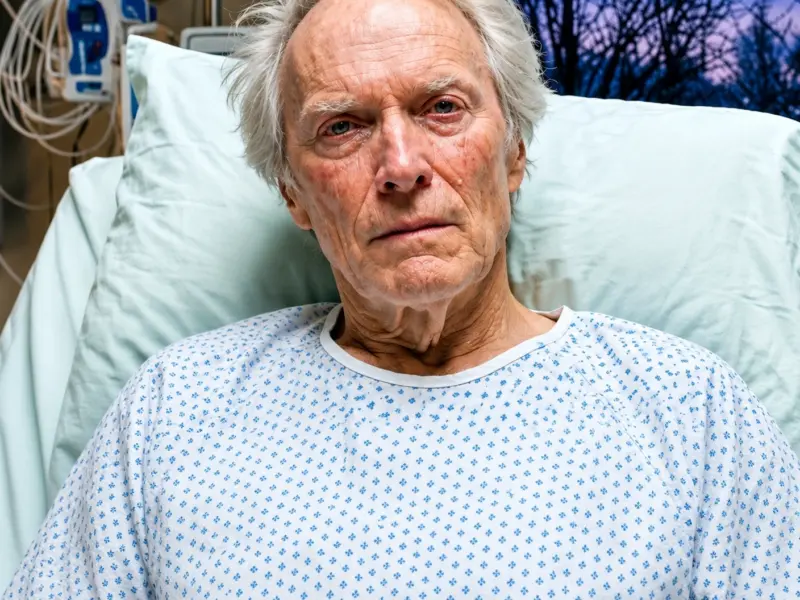
At 96, The Tragedy Of Clint Eastwood Is Beyond Heartbreaking – Try Not to CRY

At ninety-six, Clint Eastwood has reportedly stopped making movies, and there was no farewell tour and no final speech.
His son Kyle simply told a French outlet that his father is retired.
The last film he directed, Juror Number Two, came out when he was ninety-four.
That same year, his partner of ten years, Christina Sandera, died of a heart attack at sixty-one, and his public statement was a single sentence.
For a man who built a legend on saying almost nothing, the silence now feels different.
So what does Clint Eastwood have left to hold on to?
In 1951, a young man in an army uniform was swimming toward a distant shoreline.
Accounts of the event vary in their details, but the widely reported version is simple.
A plane carrying Clint Eastwood went down at sea, and he swam to land on his own.
Nobody was coming to carry him.
Whatever else is true about that story, it fits the man.
By then he had already spent his youth learning how to rely on himself.
He grew up in a Depression-era family, where work was not a hobby.
His father worked for Georgia-Pacific, his mother took a clerical job at IBM, and the boy himself worked as a lifeguard, a paperboy, a grocery clerk, a forest firefighter, and a golf caddy.
None of those jobs made anyone famous.
All of them taught the same lesson: if something needed doing, he would be the one doing it.
Those were also solitary jobs, or close to it.
A lifeguard watches the water alone, a forest firefighter works in a crew but trusts his own hands, and a caddy carries someone else’s bag and keeps his opinions to himself.
It is easy to see how a young man could come out of that education believing that the safest course was to say little and do the work.
Even his own account of those years is a little slippery.
Eastwood has suggested in interviews that his family kept moving through the 1940s.
The record says they did not.
It is a small discrepancy, the kind a storyteller makes without much thought, but it hints at something.
Even then, he may have been shaping how he wanted to be seen: a drifter, a loner, a man who owed nobody anything.
Nothing here amounts to a wound.
There is no documented tragedy in his childhood, and it would be wrong to invent one.
What the record shows is a habit, formed early and held for life, of managing entirely alone and keeping his thoughts to himself.
It would become the foundation of everything that followed, the roles, the reputation, and eventually the way he faced the hardest things a life can send.
After the army, the early Hollywood years offered little to be proud of.
The small parts were small, and the doors that opened did not open very far.
Eastwood was tall, quiet, and not obviously a star.
Plenty of young men with that profile never got a second look.
He kept working, kept showing up, and kept speaking as little as possible.
There was no breakout moment, no overnight discovery, and no sign yet of the legend to come.
There was just patience, a quality that tends to go unrecorded in the biographies of famous people, and a stubbornness that kept him in the room.
That last detail matters more than it sounds.
In a business that rewards charm and talk, he did the opposite.
Silence was not yet a strategy, it was simply his nature.
But a camera is a strange instrument.
It can turn a man’s reticence into mystery and a few words into authority.
All he needed was the right role, and it was coming, not in a movie theater, but on television, on a long cattle drive.
The show was Rawhide, a western that made Eastwood a familiar face in American living rooms.
It was steady work and a real break, but it also had a ceiling.
Television stars of that era rarely became movie stars, and he knew he needed something different.
It came from Italy.
The director Sergio Leone offered him a part in a Western that would become the first of the Dollars films, and Eastwood took it.
The movies were stripped-down, violent, and strange, and they gave the world a new kind of hero.
He had no name.
He barely had dialogue.
He squinted, he waited, and then he let everyone around him do the talking.
The films were made far from the American studio system on modest budgets by a director with a very particular eye for faces and pauses.
For an actor who had learned to carry a scene with a few words, it was an ideal match.
Audiences everywhere understood him instantly.
That is the remarkable thing about the man with no name.
A character who says almost nothing leaves enormous room for the viewer to project onto him, and viewers projected strength, certainty, and a private code.
The silence that had once been simply Eastwood’s temperament had become a screen persona, and the persona was worth a fortune.
He did not waste it.
In 1967 he formed Malpaso Productions, the company that would go on to produce all but four of his American films.
The name matters less than what it meant.
Eastwood was not going to leave his career in the hands of studios that might lose interest.
He would own a piece of it, and he would control how the work got made, the way he had controlled everything else in his life by doing it himself.
It was a practical decision with a lasting effect.
Owning the company meant that when Eastwood wanted to make a small, strange film, he could.
It also meant that when the films worked, the success was his to reinvest.
Then came Dirty Harry in 1971, and the image hardened into something even more iconic.
Detective Harry Callahan was tough, terse, and uncompromising, and the character turned Eastwood into a cultural symbol of a certain kind of American masculinity.
People did not just watch him, they quoted him, argued about him, and carried him around as shorthand for a whole attitude.
It would have been easy to stop there.
Plenty of stars do.
They find the role that works and repeat it for the rest of their careers.
Eastwood chose a different path.
That same year he directed his first film, a thriller called Play Misty for Me.
And in doing so, he took a quiet step that would matter more than any gunfight.
A contradiction begins to appear here.
The world had decided who Eastwood was: the man who needed no one, said nothing, and solved his problems alone.
The performance was convincing, but it was only a fraction of the person.
The man who started Malpaso, who learned to run a set, and who chose to stand behind the camera was not just a loner on a horse.
He was an organizer, a craftsman, and someone who cared how things were built.
The icon had been made, and now he wanted to see what he could do with the tools.
Ask people who have worked with Eastwood what makes him different, and the answer is usually speed.
Where other directors run through dozens of takes, he prefers to capture the instinctive energy of a first attempt.
He trusts his actors, trusts his preparation, and moves on.
It looks casual from the outside, and it is one of the reasons he was able to direct forty films without burning out.
That reputation matters because it shaped the culture of his sets.
A crew that knows it will not be asked to repeat everything fifty times works differently.
It pays attention.
It prepares.
The efficiency was not only a way of saving money, it was a way of treating the work and the people doing it with a certain respect.
The method is also a kind of philosophy.
A first take is honest.
It has not been polished, and it has not yet had time to become self-conscious.
For a man who began his career trusting silence over speech, the preference makes sense.
The results were extraordinary.
In 1992, Unforgiven won the Oscar for Best Picture, and Eastwood won Best Director.
It was a western about an aging killer who has tried to leave violence behind and cannot quite manage it.
The film took the myth that had made him famous and turned it over.
The hero was no longer certain, no longer clean, and no longer comfortable with what he had done.
Many viewers noticed: here was the man with no name, decades later, examining the cost of a life built on toughness.
It was not a confession, and it would be wrong to read it as one, but it showed that the artist behind the persona understood more than the persona let on.
Over the following years the achievements piled up.
Mystic River told a harrowing story about three childhood friends and a crime that tears them apart, and it remains one of his highest-rated films.
He also composed the piano theme that runs through it, a detail that says something about him.
When a story needed to say what words could not, Eastwood reached for music.
His son Kyle, a musician, would go on to contribute to the scores of nine of his father’s films.
Then came Million Dollar Baby in 2004, which also won Best Picture and Best Director.
Gran Torino followed in 2008 with Eastwood himself in the lead.
Somewhere in this stretch he also served a term as mayor of Carmel-by-the-Sea, the small California town he called home, a reminder that he was never quite as detached from community as his character seemed.
Add it up, and the career is remarkable: forty films as director, two Best Picture winners, two Best Director Oscars.
But the numbers miss the pattern.
In film after film, the work kept returning to the same figure, an older man haunted by what he has done and what he has missed.
For an artist who gave almost nothing away in interviews, the movies were as close as the public came to hearing him think.
It is worth pausing on how unusual that is.
Many stars of his generation made their money and moved on.
Eastwood kept choosing material that questioned the image that had made him rich, as if the persona were a subject he was still working out.
That willingness to risk the brand is a large part of why critics took him seriously.
That is why the work mattered so much.
It was not a hobby, and it was not simply a job.
It was the place where he spoke, and the more the work spoke for him, the less anyone thought to ask about the man who made it.
If the films were the place where Eastwood spoke, his private life was the place where he mostly did not.
The public facts are these.
He married Maggie Johnson in 1953, and the marriage ended in the decades that followed, though sources differ on exactly when, with a separation reported in 1964 and a formal end in 1984.
In 1996 he married the television news anchor Dina Ruiz, and that marriage lasted until 2014.
In between there were other relationships, some well known and some kept quiet.
For a man whose screen image was so self-contained, the real-life version was surprisingly busy.
Marriages began and ended.
Relationships overlapped with careers and with the making of films.
And through all of it he kept working, as though the one fixed point in his life was the next project.
One of the best known was with the actor and director Sondra Locke.
Their relationship ran for years and ended in the late 1980s in a legal dispute that was widely covered at the time.
The public record is more complicated than the headlines were, and nothing here should be read as assigning blame.
What can be said is that it became one of the most visible episodes of his personal life in an otherwise guarded existence.
The details of that dispute belong to the people who lived through it, and the story can only note its existence.
Even a man who says very little cannot always control how others tell his story, and for a time others told his.
There was also the actor Frances Fisher, and there are the children.
When you count them up, the number is striking.
Eastwood has eight children with six different women, per published accounts.
Several of them, including Kyle, Scott, Allison, and Morgan, have worked with him or around him.
Over the decades they became part of his professional world, which meant that for him the line between family and work was never as clean as it is for most people.
It is tempting to read all this as a pattern, and there is a risk in doing so.
A list of relationships tells you what happened.
It does not tell you what anyone felt.
Eastwood has said very little about his private life, and we do not have his account of what any of it cost.
It would be dishonest to supply one.
What we can do is notice what the record includes and what it leaves out.
It includes names, dates, and families, all public.
It leaves out explanations, and that absence is itself quiet information about the man.
Still, the outlines are visible.
A man who spent his career telling stories about solitary men did not, in practical terms, live a solitary life.
He had spouses, partners, and a large family.
And yet the way he lived through it, quietly and without explanation, matched the persona almost perfectly.
His feelings, whatever they were, stayed where the public could not see them.
Whether that was a defense, a preference, or simply a temperament, no one outside his circle can say with certainty.
The documentary record supports only the observation, not the explanation.
That choice has consequences.
When a person declines for decades to explain himself, everything he does say carries more weight, and everything he leaves unsaid becomes part of the picture.
The silence that had made him a star was now part of how people understood his life, and it was not always a comfortable fit.
By his late seventies he had the career, the awards, the family, and a long history of relationships that the public had followed from a distance.
What he did not have was an ordinary life.
Fame had made quite sure of that, and at an age when most people stop, he showed no sign of stopping.
In 2014 American Sniper arrived, and by early the following year it had been nominated for six Oscars.
Eastwood was eighty-four.
Most directors his age are retired or being honored for work done long ago.
He was still on set, still making decisions quickly, and still delivering films that audiences wanted to see.
Hollywood is not sentimental about elderly directors.
Scripts, budgets, and schedules do not bend for a legend.
He kept getting films made because the films kept working.
He kept going.
He directed Sully, and then he did something that a director in his late eighties rarely does.
He put himself back in front of the camera in The Mule as an older man whose life has drifted far from where he thought it would go.
In 2021, at ninety-one, he directed and starred in Cry Macho, and in 2024, at ninety-four, he released Juror Number Two.
Consider that for a moment.
Most people spend their ninth decade slowing down.
Eastwood was running sets.
The stamina alone is remarkable.
In their nineties, most people are glad to be out of the house, let alone running a production with a crew, a schedule, and a budget.
The pace was his, and he kept it.
But the more interesting thing is what the later films chose to look at.
Old men, again and again.
Men with regrets, men who have made mistakes, men trying to decide what to do with the time that remains.
Taken together, they form something close to a late style: spare, unhurried, and focused on consequences.
The action is quieter.
The jokes are drier.
The questions are bigger.
It would be wrong to read these films as autobiography.
Eastwood has never invited that kind of reading, and the characters are not him.
But it is fair to notice the pattern.
At the age when most people begin looking back, he was making films that looked back for him.
In a way, the movies became the one place where an aging man could think aloud without having to explain himself.
The work also did something else.
It kept him in the world.
A film set is a community with its own routines, rules, and people.
For someone whose life had always been organized around making things, the work was a structure, a reason to get up, and a place to belong.
There is another side to that structure.
When your life has been organized around making things, the absence of a project is not rest.
It is a vacancy.
That may be one reason the question of retirement hung over him for so long, even before anything changed.
Every film he finished was another proof that he could still do what he had always done.
That is why each new movie carried an unspoken question.
Every time he finished one, people wondered whether it was the last.
Eastwood never answered.
He did not issue statements about his plans.
He did not hint at endings.
He let the films and the long gaps between them speak for him.
He simply made the next one until, at ninety-four, with Juror Number Two, he made one that turned out to be different.
We will come back to that film and to what happened around it.
But first it is worth meeting the person who was standing beside him while he made it, because while the world watched the old director keep working, someone had been at his side for years.
The story begins at a hotel.
Mission Ranch in Carmel is a hotel and restaurant that Eastwood owned, and in 2014 a woman named Christina Sandera worked there as a host.
That is where they met.
It was the same year his marriage to Dina Ruiz ended, and the timing has been noted by nearly everyone who has written about it.
The two became a couple shortly after.
The public record is thin, and that thinness is part of the story.
Eastwood did not talk about it, and neither did she.
For a man who had been the subject of so much attention, a quiet relationship was almost a quiet statement in itself.
People who lead public lives often hold something back to protect it.
The relationship appears to have been one of those things.
It was visible enough to be real and private enough to be theirs.
What we can say is what we can see.
Sandera accompanied him to the 2015 Academy Awards, the year American Sniper was nominated for six Oscars.
She appeared at film premieres and at other public events.
She was described in later accounts as a person who cared about charitable causes.
She was there for a full decade.
A decade is a long time in anyone’s life.
In the life of a man in his eighties, it is a large part of what remains of the story.
The Oscars and the premieres were only the visible edges of something that mostly happened where no one was looking.
There is a particular kind of relationship that develops late in life.
It is not about building a future so much as about having company in the one that remains.
For a man who was in his eighties, with a career that had cost him most of his privacy, a partner who kept things quiet may have meant a great deal.
That is interpretation, and it is offered with care.
Neither of them ever described it that way.
In June 2024, Eastwood’s daughter Morgan married Tanner Koopmans.
Eastwood attended, so did Sandera, so did Morgan’s seven siblings, all of them together at the same celebration.
It was the sort of family gathering that happens in many households, and it was documented because of who was in the photographs.
For a moment at least, it looked like a man at ease among the people he loved.
It is a small thing, and the story should not make too much of it, but it matters for what comes next.
A family together, a partner at his side, a new film in post-production, and a career that, for the first time in decades, did not seem to be asking anything more of him.
A few weeks later, everything changed.
On a Thursday in July 2024, Christina Sandera died.
She was sixty-one.
The news reached the public the following day in a statement Eastwood gave to The Hollywood Reporter.
It was a single sentence.
He called her a lovely caring woman and said he would miss her very much.
That was all there was.
A spokesperson for Warner Bros. told the same publication that no further information would be released because Eastwood wished to grieve privately.
In the days that followed, the Monterey County Health Department confirmed that she had died of a heart attack.
Her death came with no illness anyone had announced, no long goodbye, and no warning that the public knew of.
For any family, a sudden death arrives without a script.
There is no time to prepare, and the people left behind are asked to carry on in the same routines that the person was part of.
His daughter Morgan, whose wedding Sandera had attended a month earlier, paid tribute on social media.
She thanked Sandera for being a good partner to her father.
The words were brief, and they were not about the legend or the filmmaker.
They were about a man whose partner had died, and about how his family saw what she had given him.
Think about how little we are given.
A single sentence, a brief note about privacy, a cause of death, and a daughter’s thank-you.
That is nearly the entire public record of one of the most significant losses of his later life.
Everything else, the private details that surround any death, stayed behind a closed door by design.
That is not unusual.
It is what privacy looks like when someone insists on it.
And it is exactly what the story of Clint Eastwood would lead you to expect.
Some will find that cold.
It may be the opposite.
When a man has made reticence the language of his life, a short statement can carry more feeling than a long one.
This is where the silence changes.
For most of his life, his reticence was a style, a persona, a way of working.
In July 2024, it became something else.
It was what a man does with grief when he has spent ninety-four years declining to explain himself.
We do not know what he felt and no one should claim to.
What we can say is that his response was consistent with everything he had always been.
Months later in the fall, Juror Number Two was released.
Eastwood was ninety-four.
Critics praised it and it is among the most highly rated of his later crime thrillers.
Anyone watching was seeing a director in his nineties finish a story as carefully as he had finished all the others.
It would be easy to read the film as an elegy and some did, but we have no evidence that he intended anything of the kind and no one should put words in his mouth.
What is clear is the sequence.
A loss in July, a film in the fall.
It is a sequence and nothing more because the record does not link the two.
And then, as far as the public could tell, nothing.
There was no announcement, no final interview, no farewell, no tour.
The man who had made a movie nearly every year for decades simply stopped appearing.
For a long time no one could be sure why.
That quiet is what the rest of this story has to explain.
The explanation, such as it is, came from his son.
In an interview with a French outlet in November 2025, Kyle Eastwood said that his father had stopped working.
He spoke warmly about the films they made together, calling it a great experience.
The interview did not receive wide attention at first.
It surfaced in the English-language press in June 2026 and the headline was simple: Clint Eastwood is retired.
It should be said clearly that this is only a report.
Eastwood’s representatives had not publicly confirmed it at the time.
That caution matters.
An icon’s retirement is the kind of news that spreads faster than it can be checked, and the story is better served by saying what is known than by announcing what is not.
But the surrounding facts line up.
Juror Number Two, released when he was ninety-four, is his most recent film.
No new projects as a director or actor are listed, and there have been no public signs of anything in production.
There has also been confusion.
In 2025 an interview circulated in which he was said to be planning more work.
Eastwood called it phony.
That single word tells you something about how he deals with the world.
He does not issue long rebuttals.
He corrects the record in as few words as possible.
It is also a reminder that at ninety-six he is still the person deciding how much of his life becomes public.
What does a man like this do with his days?
Here the record gets thinner.
An unnamed source told one outlet that he has been splitting his time between homes on the California coast and Hawaii, and that his main hobbies now are playing piano and making art for himself.
That is a claim from an anonymous source, and it should be treated as one.
But it is consistent with what we know.
He wrote the theme for Mystic River, and his son has spent a career in music.
Sound was the one language he used when words would not do.
There are also darker claims.
One tabloid reported, through an unnamed source, that he was having a hard time.
It is the kind of thing that is easy to say and impossible to verify, and nothing in the documented record supports building a story on it.
We will leave it where it belongs.
So what is left?
Start with what is certain.
He turned ninety-six on May 31, 2026.
He has directed forty films, including two Best Picture winners.
His films are still being watched, still being streamed, and still being argued over.
Those facts cannot be taken from him.
Consider what that means.
A long life tends to be measured by what it takes away: jobs, friends, strength, partners.
Eastwood has lost some of these, but what a person has built does not retire, and the films keep working on audiences who were not born when they were made.
Then there is the family: eight children, several of whom grew up in and around his work, and who have spoken warmly of it.
They were with him at a wedding a month before the loss.
Whatever else changes, that does not.
The children also carry something forward.
Some, like Kyle, grew up as collaborators, contributing music to nine of their father’s films.
Some, like Scott, appeared in his movies.
Whatever he has retired from, those creative threads were woven through his family long before and may well continue beyond him.
And there is the music, and the art, and the quiet.
These are small things compared to a career that shaped American cinema, but they are real, and they are his own.
The truth is that the answer to what remains is both smaller and larger than the legend.
Smaller because it does not involve cameras, crowds, or awards.
Larger because it is made of the things that were there before the fame and will be there after it.
People, work done with the hands, and a private life that is finally allowed to be private.
Most of his inner life still remains his own.
That is not a gap in the story.
It is the story.
Go back to the beginning.
A young man in the water, swimming toward land with no one to help him.
It is tempting to read the whole life as a long swim, self-reliance, silence, and work done alone all the way to shore, and in many ways the record supports that.
He built a persona out of few words, a career out of his own company, and a body of work out of first takes.
When his partner of ten years died, he answered with a single sentence, but that is not the whole picture, and the later chapters complicate it.
The man who needed no one had a family that surrounded him at a wedding.
He had a partner who stood beside him for a decade, and he had a son who, when asked, said simply that his father had retired with warmth and without drama.
Fame gave Eastwood almost everything a performer can be given.
It gave him an image that people still quote, a career that shaped the way films are made, and a freedom to work on his own terms that few directors ever get.
It also took something.
It took the ordinary privilege of being allowed to simply live.
Every loss he has suffered has been, to some degree, a public one, and every silence he has chosen has been read as a statement.
Perhaps that is why his story feels both heartbreaking and, in its own way, strangely undramatic.
That is not a failure of the story.
A life like this does not resolve into a neat lesson, and the honest ending is an open one.
There is no scandal here.
There is no collapse.
What there is is a long life, which always ends with loss.
The only unusual thing about Eastwood’s is that the world has been watching him for seventy years, and that he has never once explained it.
So what does he have left to hold on to?
He has the piano.
He has the art.
He has children who are still making their own work, and a catalog of films that will be watched long after anyone alive today.
He has a quiet that he chose long before he needed it.
Most of all, he has the thing he has always had: his own company, his own pace, and the habit of getting on with it.
The silence that once made him a legend is now simply what he is left with.
It is a quiet, and it is his.