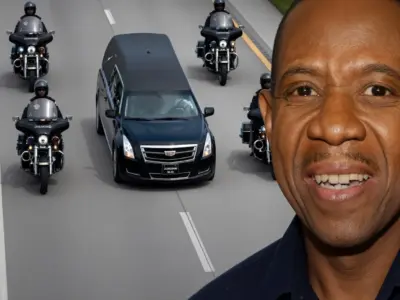
William Shatner’s Final Words About Patrick Stewart Will Melt Your Heart

On October 29, 2026, a family statement went out that made Star Trek fans stop what they were doing.
Sir Patrick Stewart, the man who played Captain Jean-Luc Picard, had died at the age of eighty-six.
Within hours, tributes poured in.
Hugh Jackman, George Takei, even Marvel Studios.
But among Star Trek fans, one name mattered more than any other: William Shatner, the original Captain Kirk, the man who had commanded the Enterprise two decades before Picard ever took the chair, and for a long time, a man whose relationship with Stewart was not as simple as the photographs made it look.
William Shatner had something deeply personal to share about his longtime friend, Patrick Stewart.
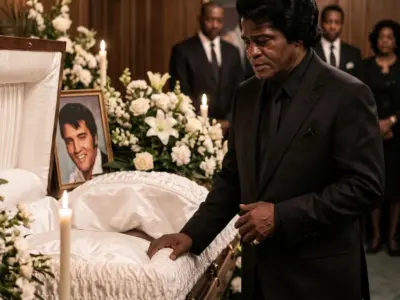
Standing at the microphone, he appeared emotional as he spoke while mourners gathered nearby in a church beside a casket covered in white flowers.
His heartfelt words made the tribute even more touching, reminding everyone of the bond they shared.
You may have seen headlines saying Shatner finally spoke.
The truth is more interesting than that.
He did not stay silent.
He spoke fast.
And what he chose to say, and what he left unsaid, tells a bigger story than any single statement.
Because there was a moment thirty-two years earlier when these two men met for the first time, and it did not go smoothly.
There was a film in which one of them buried the other, and there was a documentary in which Shatner sat across from Stewart and asked what it means to be a captain.
So what actually happened between Kirk and Picard?
Why did one sentence in Shatner’s tribute matter so much?
And why does this particular loss feel different from every other Star Trek farewell?
To answer that, we have to start with the week itself, because it was already a terrible week before the news about Patrick Stewart arrived.
Earlier that same week, the Star Trek world had lost Walter Koenig.
Koenig played Pavel Chekov on the original series.
He was ninety years old.
Shatner posted a public tribute to him too, even though he had admitted to some differences with Koenig during his lifetime.
Fans had barely finished grieving.
Then a few days later came the second announcement.
According to his family, Patrick Stewart died on Wednesday, October 28, at his home in Los Angeles.
The announcement came the next day.
His representative described his final stretch as a brief and poignant journey with Alzheimer’s disease and Lewy body dementia.
Two losses in one week.
Two different eras of the same franchise.
And for the man who stood at the very start of that franchise, it landed in a particular way.
Shatner turned ninety-five this year.
He is now alongside George Takei, the last surviving member of the original Star Trek cast.
Think about what that means.
Every person who stood beside him on that original bridge is gone, apart from one.
And now the man who played the second great captain of the franchise was gone, too.
In fact, Stewart was the first actor who had played a lead Star Trek captain to die.
Shatner’s statement appeared on Instagram and X on October 29, the same day the news broke.
So the idea that he waited or hesitated or only spoke after pressure does not match the record.
British coverage reported that fans responded to the post with a wave of support for him.
But there is a reason people expected something more complicated.
To understand why, we have to go back to 1987.
That was the year Star Trek: The Next Generation arrived with Patrick Stewart as Captain Jean-Luc Picard.
It was a big gamble.
The original series had become a cultural landmark, and the original cast had gone on to make several feature films.
Kirk was one of the most recognizable characters in the world.
Now a new ship, a new crew, and a bald Shakespearean actor from England were being asked to carry the name forward.
Stewart came from a very different world.
He had been a member of the Royal Shakespeare Company before he ever set foot on the Enterprise.
He was respected as a serious stage actor, not as a science fiction star.
Shatner, meanwhile, was already the face of Star Trek in the public imagination.
And here is where the story gets uncomfortable.
When the two men finally met years later, Stewart remembered it as a little awkward.
Actually, that is his phrase from an interview about the meeting.
He explained why.
There had been reports that Shatner had made negative remarks about The Next Generation.
Stewart said that he and his castmates had all felt uneasy about that.
Let us be careful here.
These were reports.
Stewart described them as reports, and we should too.
We do not have a recording that proves exactly what was said.
And Stewart himself was clear that the awkwardness did not last.
But the feeling was real.
A new cast carrying a legacy that did not belong to them, with the previous captain publicly said to be unimpressed.
If you are Stewart, how do you walk into a room with Kirk?
The answer arrived with a movie, and one scene in that movie matters more than any other for a reason that only became clear this week.
In 1994, Paramount released Star Trek Generations.
It was designed as a handoff.
The old crew was fading out of the films.
The new crew was taking over.
And the studio had an idea that fans had dreamed about for years.
Put both captains in the same story.
The plot used a bit of science fiction logic to make it work.
Kirk had spent decades frozen in time inside a strange place called the Nexus, a place that gives you what you want most.
Picard, in a crisis, needed Kirk’s help and went in after him.
Their first scenes together are the highlight of the film.
Picard has to convince Kirk to leave the Nexus and return to reality for one last adventure.
Most critics and fans do not rank Generations among the best Star Trek movies.
It is generally not a fan favorite, but those scenes between the two men work.
Shatner holds his own opposite Stewart, and that matters because Shatner is so often dismissed as a ham.
He has even leaned into that for comedy, most famously as Denny Crane on Boston Legal.
What people forget is where he started.
In the 1950s, Shatner was part of Ontario’s Stratford Shakespeare Festival.
He was a stage actor, too.
Two men who would later be remembered for science fiction both began in the theater.
On the promotional trail for that movie, Stewart told a story that shows how quickly the tension eased.
He recalled that Shatner saw him leaving an event and said he would like to go too.
Stewart offered him a lift on Paramount’s private jet.
Two captains sharing a plane.
Stewart said that by the time they made the movie together, the awkwardness was long gone.
They had, in his words, a grand time.
But the film had a darker purpose.
Its story ends with Kirk’s death.
And it is Picard who stays behind to carry his memory.
That image has haunted fans for decades.
Picard, the younger captain, honoring the older one.
It was a symbolic passing of the torch, written for the screen by people who could not have known how it would read three decades later.
At the time, it was a story about one era ending and another beginning.
Today, it reads like a rehearsal, which is exactly why what happened this week felt like a reversal.
Thirty-two years after Generations, the roles have swapped.
Shatner is the one still here.
Stewart is the one being remembered.
And that brings us to the statement itself.
Shatner opened by saying it had been a heartbreaking week.
He called Stewart a friend, a colleague, and a magnificent actor.
Notice the order of those words: friend first.
He went on to say that across stage and starship, Stewart brought intelligence, grace, and humanity to everything he did.
He said Picard embodied the best in people, and that the actor who played him did too.
He said he was filled with affection and admiration, and he sent his condolences to Stewart’s wife, Sunny Ozell, and to the family.
Read those lines again and think about who wrote them.
Fans had spent decades framing these two as rivals.
Shatner did not mention that.
He did not hedge.
He did not turn it into a story about himself.
He praised the work, and he praised the person.
But here is the part most headlines missed.
The sentiment in this statement was not new.
Years earlier, Shatner had already said something remarkable about Stewart, and it had nothing to do with a death.
According to reporting on one of his interviews, Shatner said that watching Stewart play Picard on The Next Generation renewed his own passion for Star Trek.
He described the performance as a great piece of work.
Stop and think about how unusual that is.
The original captain watching the actor who inherited the franchise and being moved by what he saw.
It is easy to imagine a different story: a veteran star resenting the younger man who took over the role his series made famous.
Plenty of actors in that position might have.
But the record points the other way.
Stewart’s work did not threaten Shatner.
By Shatner’s own account, it brought him back to something he had helped create.
That does not erase the reports of unkind remarks in the late 1980s, but it shows how far the relationship traveled.
And that journey became public in 2011.
In 2011, Shatner released a documentary called The Captains.
The idea was simple and a little risky.
Shatner would visit the other actors who had led Star Trek series and ask them about their lives, their careers, and what it was like to wear the captain’s uniform.
Patrick Stewart was one of them.
So were Avery Brooks, Kate Mulgrew, and Scott Bakula, along with Chris Pine, who played Kirk in the 2009 reboot.
The film was a chance for Shatner to ask a question he had been circling for years.
What does it mean to be the face of something bigger than yourself?
It is a question that only a handful of people on Earth could answer with authority.
Each of the men and women in that film had been asked to carry a franchise that predated them and would outlive them.
Each had to decide how much of themselves to give to a character and how much to keep.
Stewart was one of the voices Shatner sought out.
They had the same job, separated by two decades and one very long shadow.
The film’s own description says it follows Shatner as he comes to terms with his work on the original series and with what he will leave behind.
Life, death, and legacy.
In 2011, those were abstract ideas.
Today, they are not.
Watching Stewart sit across from him in that film, two veterans talking about what a character leaves behind, feels very different now.
One of them is gone.
The other is ninety-five.
Shatner was asking in 2011, what remains when the actor is no longer there?
This week, the world began to answer.
But if Shatner’s statement was warm, why did so many people spend the week talking about it?
Part of the reason is that celebrity tributes are usually predictable.
A photo, a few lines, a heart emoji.
Fans have seen it a thousand times.
This one was different because of who it was between.
For decades, fans have enjoyed arguing about Kirk and Picard.
Who was the better captain?
Who was the better actor?
Who was the better leader?
It became a kind of friendly sport.
Kirk was the brawler, the romantic, the gambler.
Picard was the diplomat, the philosopher, the man who would rather talk than fight.
The two men were treated almost as rivals by the audience, even if they were never rivals in life.
So when one of them died, the question that hung in the air was in its simplest form: what would the other one say?
And the answer was not a rivalry at all.
It was affection.
That is part of why the statement spread so widely.
People had expected a polite tribute.
What they read sounded like something a person actually meant.
It also helped that the statement was short.
There was no long speech, no attempt to explain the past, no reaching for headlines, just a colleague saying what Stewart had meant to him in plain and generous language.
There was another reason, too.
When Stewart returned to Star Trek in recent years, Shatner noticed.
Stewart came back as an older Picard in the series Star Trek: Picard.
It was his first return to the franchise since 2002.
When the news broke, Shatner raised a glass in his honor.
It was a small gesture, but it fit the pattern.
Over the decades, the relationship moved in one direction: awkward first meeting, easy friendship on a plane, a shared film, a documentary interview, a raised glass, and finally a goodbye.
The final season of Star Trek: Picard premiered in February 2023.
Stewart was visibly part of the franchise again, and that for many viewers felt like closing a circle.
His public appearances after that were few.
According to reports, his last major public appearances came back in 2024.
Then the family’s statement.
It said he had gone through a brief and poignant journey with Alzheimer’s disease and Lewy body dementia.
We should say plainly what that means and what it does not.
It is a diagnosis his family chose to share in their announcement.
Beyond what they said, details are private and nothing in the reporting suggests anything else.
For the people who loved his work, there is a particular sadness in a mind like that being affected by that kind of illness.
Stewart was a man whose voice and presence had defined one of the most beloved characters in television history.
And Shatner, who had spent years reflecting on legacy, chose to focus on what Stewart gave, not on how it ended.
Meanwhile, the wider reaction kept growing.
Hugh Jackman, who worked alongside Stewart in the X-Men films, paid tribute to him as a giant of stage and screen and a true friend.
He said he had learned a great deal from him and that he would miss him for the rest of his life.
Marvel Studios paid tribute as well, and so did other members of the Star Trek family, including George Takei.
The pattern was clear.
Stewart had two famous lives, one in space and one among superheroes, and both communities felt the loss at the same moment.
For younger fans, it can be hard to feel how much history is packed into those tributes.
Many people met Picard before they ever met Kirk.
Others did the opposite.
Either way, the two captains became a kind of shared language.
You could tell a lot about someone by which one they preferred.
That is why the news hit so broadly.
Losing Stewart did not just mean losing one actor.
It meant losing a way that millions of people had learned to think about leadership, patience, and decency.
But among the Star Trek tributes, Shatner’s carried a special weight because of the timeline.
The original series began in the 1960s.
The Next Generation arrived in 1987.
Generations brought them together in 1994.
The documentary came in 2011.
Stewart’s final season as Picard premiered in 2023.
That is more than half a century of one franchise with Shatner present for almost all of it.
When he wrote his tribute, he was not writing as a fan or as a coworker.
He was writing as the person who had watched the story from the beginning and who knew better than almost anyone what it means to give your face to a character the world will not let go of.
So what do we actually know?
We know that Patrick Stewart died on October 28, 2026, at eighty-six, and that his family announced it the next day.
We know that William Shatner responded publicly the same day the news broke with a statement posted on Instagram and X.
We know that the two men met in 1994, that the early awkwardness gave way to friendship, and that Shatner has spoken before about being inspired by Stewart’s work.
We know that both men started in the theater, and we know that the franchise they led has now lost two of its original voices in a single week.
What we do not know is more important than it might seem.
We do not know what the two men said to each other in private over the years.
We do not know whether Shatner and Stewart spoke in the weeks before Stewart’s death.
And we do not know with certainty exactly what Shatner said about The Next Generation in the late 1980s, only that Stewart said there were reports.
Anyone who tells you they know those things is guessing.
And that is exactly why a short, sincere statement can say more than a long, speculative video ever could.
It sticks to what the person actually chose to put on the record.
It is also worth saying, because the title you clicked on suggested a secret, a silence, a confession finally broken.
There was no secret.
There was a man who lost a colleague and wrote what he felt.
Sometimes that is all a story is.
The internet tends to look for conflict because conflict travels faster than kindness.
But when the facts are laid out in order, the more accurate story is also the quieter one.
And that quieter story is the one behind the headline.
Here is what it really comes down to.
Kirk and Picard were never meant to meet.
They belong to different centuries, different crews, different decades of television.
They were two answers to the same question.
What does a good captain look like?
Kirk answered with courage and instinct.
Picard answered with reason and restraint.
For years, fans assumed that the men who played them must feel the same tension.
And at the start, perhaps there was a little.
Stewart said so himself.
But the actual story ended up somewhere different.
In the end, the story is not about who was the better captain.
It is about what two very different men managed to build between them across a fictional gap of a hundred years and a real gap of three decades.
Shatner’s own words said it better than any headline could.
And somewhere on a bridge that exists only in our memories, a chair is empty.